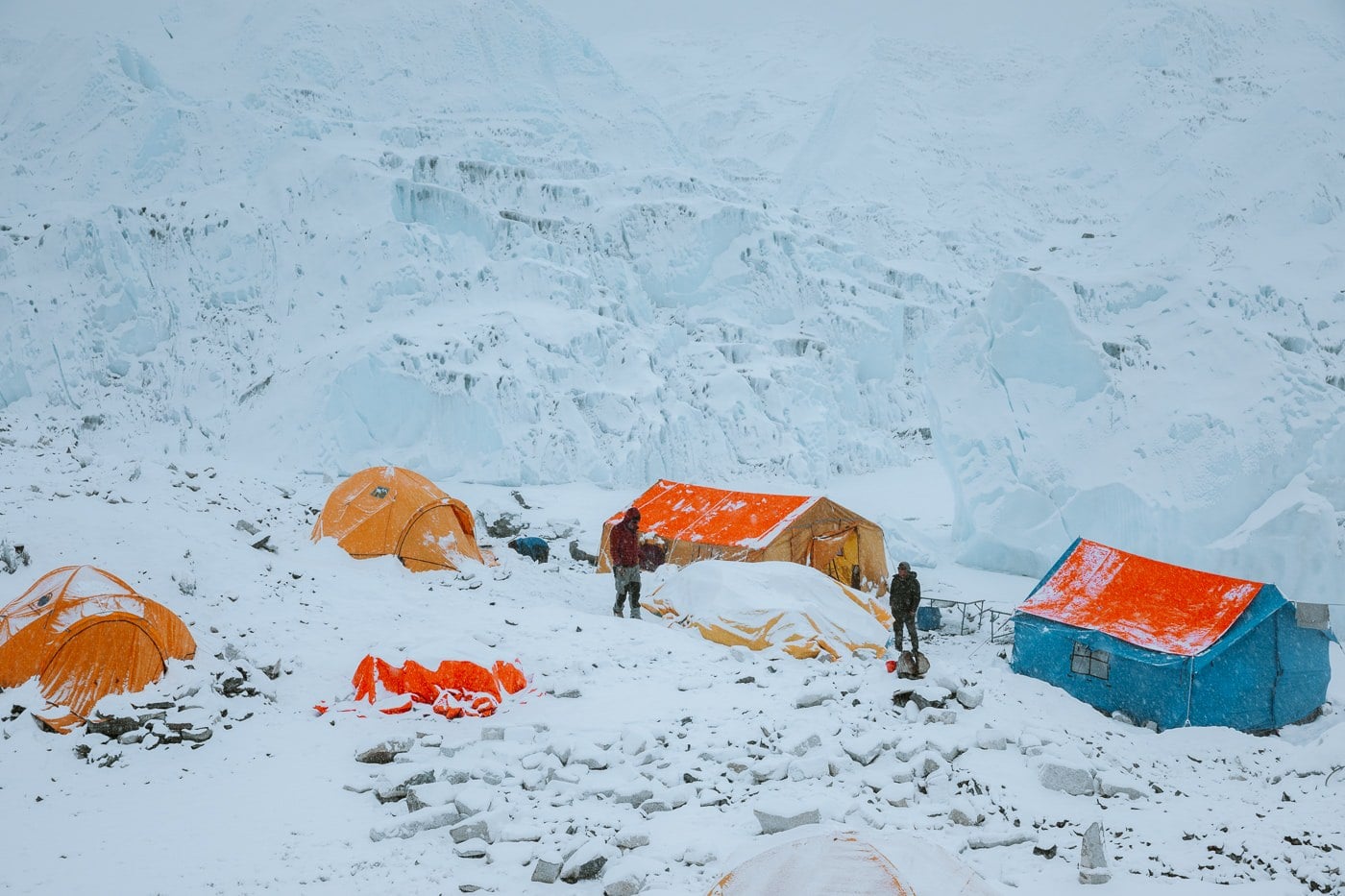


Walking to the foot of the tallest mountain on earth comes with a certain prestige. It also comes with a reputation for being properly difficult. So when people ask me how hard the Everest Base Camp trek really is, the honest answer usually surprises them: it’s easier than you’d think.
Around 60,000 trekkers walk this route every year. Surprisingly, that includes kids, retirees, and plenty of people who’ve never set foot on a multi-day trail before. In fact, in my experience the EBC seems to be one of the most popular first high altitude multi-day treks for backpackers and travelers I’ve met around Asia.
A lot of that comes down to infrastructure – the modern Khumbu has espresso machines in Namche, hot showers, tea-house mattresses, and wifi most of the way up. The route is also extremely well established.
What it doesn’t lower the bar on is the altitude or the cold. Let me tell you both are no joke. I’ve been into the Khumbu across four trips now, first on the Three Passes loop, then back for Gokyo Lakes and to summit Island Peak and Mera Peak, and below I’ll break down exactly how hard EBC actually is and how it compares to the other Himalayan treks I’ve done.
Who Is the Everest Base Camp Trek For?
If you're already considering EBC, chances are you can do it. But it pays to know who this trek actually suits before you commit. Following a normal EBC trekking itinerary - this involves a 12-day trip into thin air, and that's a long stretch to be miserable if it's the wrong fit for you.
EBC is a great trek for you if:
- You can comfortably hike five to seven hours a day with a daypack and don't fall apart on long descents.
- You've done at least one multi-day trek before - even a three- or four-day one in your home country counts.
- You're between average and good fitness: gym a few times a week and occasional weekend hikes is plenty.
- You're chasing a Himalayan view trip without wanting to learn rope work, ice axes, or technical mountaineering.
- You're happy with basic tea house accommodation: shared bathrooms, no insulation, instant coffee unless you splurge.
- You have at least 14 days of holiday including travel: the trek itself is 12 days but you'll want buffer for Lukla weather delays.
EBC might not be the right trek for you if:
- You've got a known cardiac or pulmonary condition, sickle cell, or recent surgery, get a doctor sign-off before you spend a cent on this.
- You hate cold: nighttime temperatures at Gorak Shep drop to -15°C (5°F) and there's no central heating anywhere on the trail.
- You expect comfort: there are no luxury lodges above Lukla and the toilets get progressively worse the higher you go.
- You're chasing solitude: 60,000 trekkers a year means the standard EBC route is busy in peak season, particularly between Namche and Tengboche.
- You've got under two weeks of holiday: rushing the acclimatization days is the single biggest reason people don't make it to base camp.
- You've never hiked a hill in your life: you can probably still do it, but you'll have a much better time training on a shorter, lower trek first.
If you're nodding to the first list and a bit nervous about the second, you're exactly who I wrote this post for. The day-by-day breakdown below will tell you exactly the most difficult parts about trekking to Everest Base Camp.

How High Is Everest Base Camp Above Sea Level?
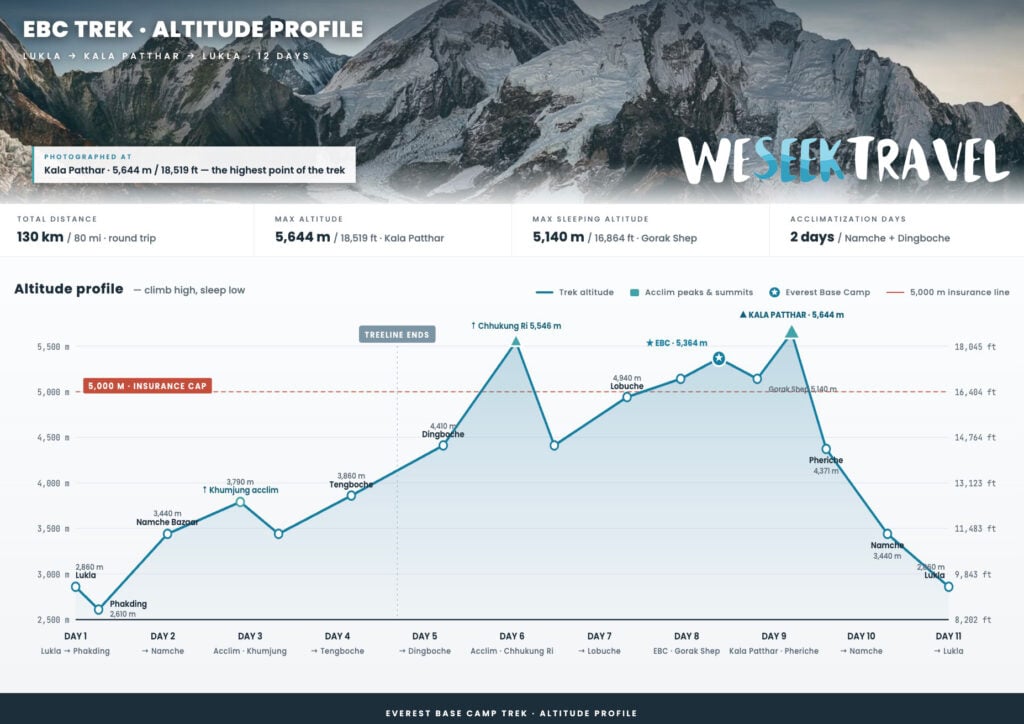
Everest Base Camp sits at 5,364 meters (17,598 ft) above sea level. That's high enough that the air you're breathing contains around half the oxygen you'd find at home. If you want a single answer to how hard the Everest Base Camp trek is, it's this number and this is what is hardest for most people.
Insurance for Trekking & Climbing in Nepal
Read the fine print– Most travel insurance companies void coverage as soon as you step over 5,000 m. That's why I use and recommend Global Rescue, as the best high-altitude trekking insurance (no altitude caps).
EBC isn't actually the highest point of the trek
That's Kala Patthar at 5,644 meters (18,519 ft), the rocky viewpoint above Gorak Shep where you'll hike at sunrise on Day 9. The trek to Kala Patthar isn't particularly difficult and the altitude isn't too bad either, since you would have likely already spent a night at Gorak Shep and you'll be well acclimitized by this stage (assuming you've followed an appropriate itinerary).
Tip: From base camp itself, you can't actually see Mount Everest's summit. It's hidden behind the Khumbu Icefall and the surrounding peaks, this is why most EBC trekkers will also climb Kala Patthar.

Altitude is the difficult part about trekking to EBC
Let me tell you, this is the most important thing to understand before booking. The EBC trail is wide, well-graded, and non-technical from Lukla all the way up to base camp. There's no climbing, no ropes, no ice axes.
What makes EBC hard is what's happening inside your body at altitude.
Above 3,000 meters, your body has to work harder for every step. Sleep gets disturbed. Appetite drops. Headaches become routine. Above 5,000 meters you're operating on half the oxygen you've used your whole life, and there's no way around that physiology.

What the altitude actually feels like at each stage
The Khumbu route bumps you up in stages. Each one feels different.
- Lukla (2,860 m / 9,383 ft): barely noticeable for most people. You'll feel slightly short of breath on the stairs but otherwise fine.
- Namche Bazaar (3,440 m / 11,286 ft): the climb up to Namche on Day 2 is where most people first feel altitude. Heavier legs, slower pace, deeper breaths.
- Dingboche (4,410 m / 14,469 ft): poor sleep is common, appetite drops, and a low headache often kicks in. Hydration becomes your job.
- Lobuche (4,940 m / 16,207 ft): everything is harder. You'll walk slower than you think you should, and eating becomes a discipline, not a pleasure.
- Gorak Shep, EBC, and Kala Patthar (5,140 m to 5,644 m): this is the thin air. You'll stop every 20 steps to breathe. The cold bites harder. Decision-making slows. This is where the trek earns its difficulty rating.
The good news is the trek itinerary is designed around all of this. The two acclimatization days at Namche and Dingboche, plus the climb-high-sleep-low principle baked into the route, are why most fit and healthy trekkers don't find it too difficult to reach Everest Base Camp and will avoid any serious altitude problems.

More Difficult Parts About Trekking to EBC
Altitude. I already mentioned altitude but it's worth repeating since it really is what makes EBC difficult for those who haven't spent any time above 4,500 meters.
The reality is you'll be sleeping at 5,140 meters (16,864 ft) at Gorak Shep on Days 8 and 9, and standing at 5,644 meters (18,519 ft) on Kala Patthar at sunrise. That's roughly half the oxygen you'd breathe at sea level. Above 3,000 meters your sleep, appetite, and pace all start to suffer. Above 5,000 meters every step costs more.

The cold. Gorak Shep is the coldest spot on the trek. Nighttime temperatures in November sit around -15°C (5°F), and the tea house bedrooms aren't heated. The dining rooms usually have a yak-dung stove going, but once you're under your sleeping bag, you're on your own. Plan to sleep in every layer you own.

Stomach sickness at altitude. This one catches people off guard. I've been sick a few times in the Khumbu now and it is not fun. Mild food-related stomach upset is fairly common in Nepal in general, but at altitude it hits much harder.
Dehydration from vomiting or diarrhea makes acute mountain sickness significantly worse, which is why a few bad meals on the way up can spiral into a turnaround. Stick to vegetarian and dal bhat above Namche, drink only treated water, and add rehydration sachets to your EBC packing list.

What's Not As Hard As You'd Think
Honestly, EBC was easier than I expected physically and mentally (once you get over the altitude). Here's the part most people get wrong before they go.
The walking days are short. Most days you're on the trail for four to six hours, with breaks. Only a few hit seven or eight, and those are Day 2 (the climb up to Namche), Day 5 (Tengboche to Dingboche), and Day 8 (Lobuche to Gorak Shep to EBC). The rest are pleasant half-days of walking.

The altitude gains are gentle by design. The standard 12-day itinerary intentionally limits how much you go up each day, with two full acclimatization days at Namche and Dingboche. The route is built around the climb-high-sleep-low principle, which is why almost everyone who follows the itinerary properly makes it.

The terrain is way easier than people picture. With around 60,000 trekkers walking this route every year, the trails are wide, well-worn, and obvious. There's no scrambling, no exposure, and no route-finding. If you've walked a hill in your home country, you've walked harder terrain than most of EBC.

The amenities are honestly impressive. The Khumbu has come a long way in the last ten years. Every tea house from Lukla to Gorak Shep has warm food, hot drinks, and a heated dining room. Most have Wi-Fi now thanks to Starlink. Some have espresso machines (looking at you, Namche). It's a long walk into thin air, but it's not the remote expedition people picture.

Comparing EBC to Other Famous Treks
The easiest way to get a feel for EBC's difficulty is to compare it to other treks you might have done, or might be considering. Here's a quick look at how it stacks up against the three treks people most often ask about.
K2 Base Camp vs Everest Base Camp
K2 Base Camp is a significantly harder trek than EBC in every measurable way. It's longer (typically 17 to 21 days), it's more remote (camping in tents, no tea houses), the terrain is rougher (glacial moraine and scree most of the way up the Baltoro Glacier), and the optional Gondogoro La crossing involves fixed ropes and an early-morning ice traverse.
The altitude isn't dramatically higher than EBC, but everything around the altitude is harder.

EBC vs Kilimanjaro
These two are the most common "first big altitude trek" picks, and they're roughly the same difficulty for different reasons.
Kilimanjaro is shorter (typically six to seven days) but the altitude profile is much more aggressive. You can find yourself at 5,000 meters within four days of setting off, which is why Kili has a much higher altitude sickness turn-around rate than EBC. Speaking from experience climbing the Lemosho Route, the summit push from Barafu in the middle of the night is a brutal six to eight hours of climbing above 5,000 meters.
EBC is longer (12 days) but the route is engineered for acclimatization. You go higher overall on Kilimanjaro (5,895 m at Uhuru Peak vs 5,644 m at Kala Patthar), but on EBC you take twice as long to get there. You also walk and sleep in tea houses instead of camping in the cold.
After trekking both - Kilimanjaro is harder per day. EBC is harder cumulatively. Most trekkers I've spoken to who've done both say EBC was the more enjoyable trip.

EBC vs Machu Picchu (Inca Trail)
These two aren't really in the same difficulty category. The classic four-day Inca Trail to Machu Picchu tops out at 4,215 meters on Dead Woman's Pass, which is around 1,400 meters lower than EBC. It's shorter, lower, warmer, and you sleep in lower-altitude camps every night.
If the Inca Trail felt comfortable, EBC will be a real step up. If it felt hard, take that as a signal to train more before booking EBC.
The Inca Trail is a great introduction to multi-day trekking with some altitude. EBC is what you graduate to next.

How Hard Is the Everest Base Camp Trek? The Honest Verdict
Here's my answer. The Everest Base Camp trek is a moderate-difficulty trek. On a one to ten scale, EBC sits at a five. For context: the Inca Trail is a three, Kilimanjaro is a five, and the Three Passes loop is a eight.
Most reasonably fit adults who follow the standard 12-day itinerary will make it to base camp.
If you can hike for five to seven hours a day with a daypack, and you can give yourself at least 14 days off work, you can do this trek. The walking itself is moderate. The trail is wide and well-maintained. The tea houses are warm. The amenities are better than they have any right to be.
The two things that catch people out are altitude and rushing. Skip an acclimatization day to "save time" and the altitude will get you down. Show up with no multi-day trekking experience and the cumulative load wears you down. Treat the trek with the time it asks for and the route does most of the hard work for you.
If you're nervous but ready, you're the right person for this trek. Book the 12-day EBC itinerary, give yourself a few months to train, and go.
For anything harder, the Three Passes loop is the obvious next step in the Khumbu.
Adventure Aspirant
Monday 27th of July 2026
Dear Olly, Thank you so much for this informative article. It's worthy to read once by those who want to trek to Everest Base Camp.