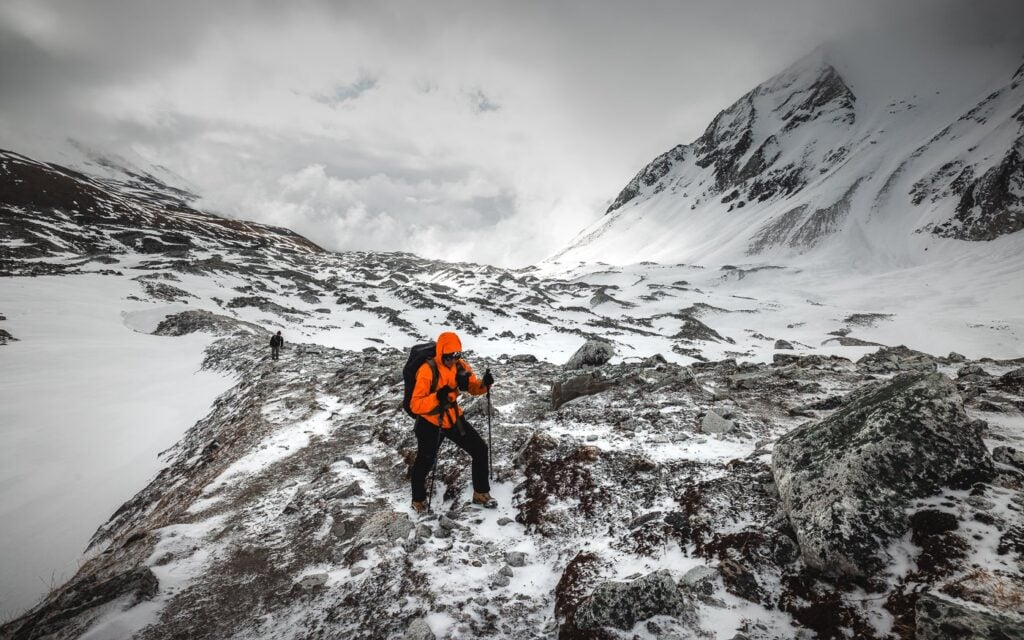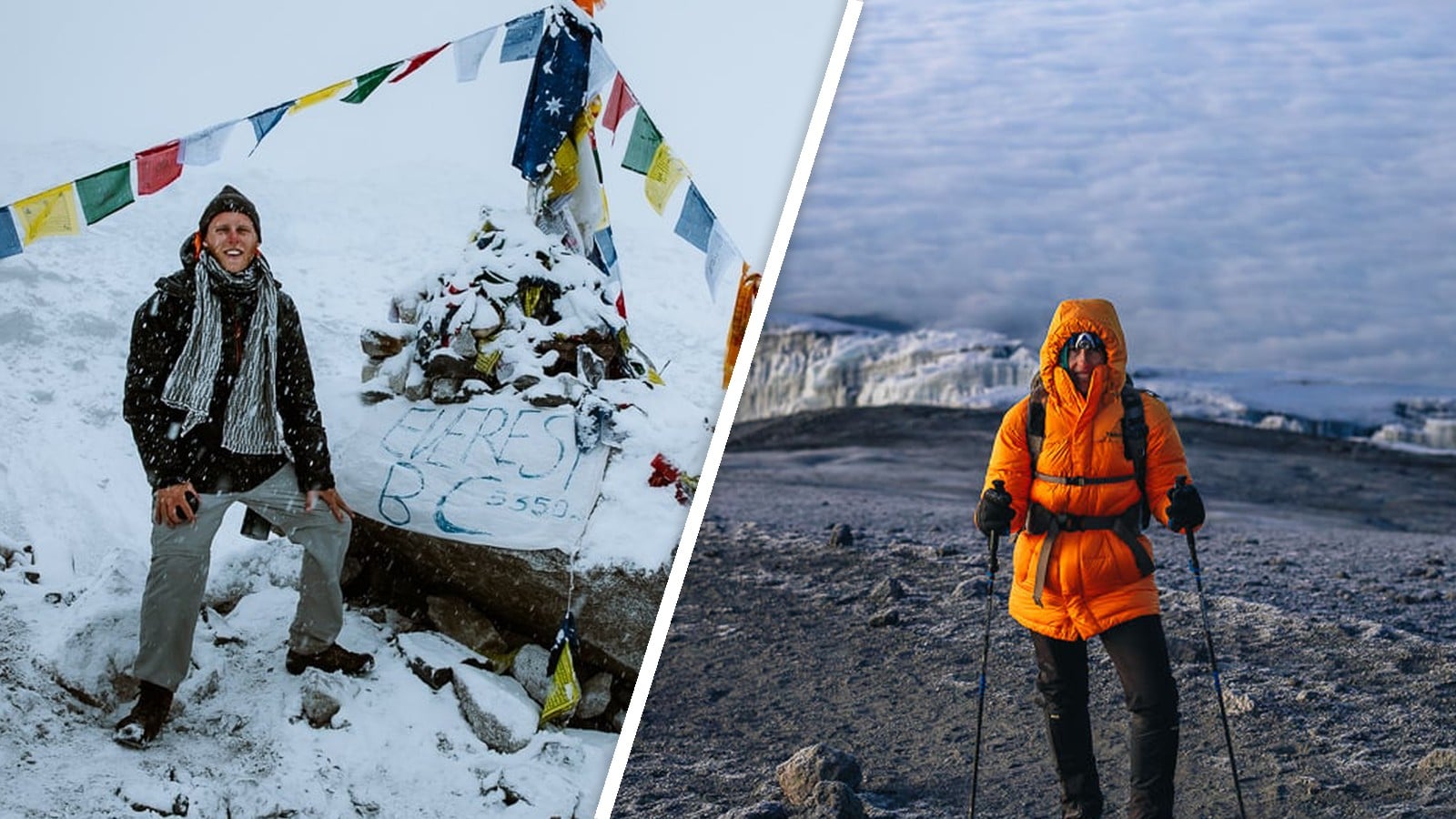


Everest Base Camp vs Kilimanjaro is the classic trekker’s dilemma: one walks you to the foot of the highest mountain on Earth, the other puts you on the literal summit of Africa.
The Everest Base Camp trek takes you through Nepal’s Khumbu valley to 5,364 m (17,598 ft), the foot of Everest, not the top. Kilimanjaro is a true summit: you climb all the way to Uhuru Peak at 5,895 m (19,341 ft), the highest point on the African continent.
I’ve done both, along with Island Peak, Mera Peak, the Three Passes and the Gokyo Lakes in the Everest region, and the Lemosho route up Kilimanjaro. So this is a straight, traveler-to-traveler breakdown of height, difficulty, cost, and which one I’d advise my friends and fellow trekkers toward.
EBC vs Kilimanjaro - Quick Overview
These two get compared constantly, but they're not really the same kind of trip. Kilimanjaro is a summit, you grind through the night to stand on the highest point in Africa, and you're done in under a week. Everest Base Camp is a slower journey through the Khumbu, sleeping in teahouses and walking to the foot of the world's highest mountain over about two weeks.
The biggest difference at the top is that when you reach EBC, you are quite clearly at the base of the Himalayan giants, you are surrounded by them. While at the summit of Kilimanjaro, you are at the highest point in Africa, and staring out over the vast plains below.
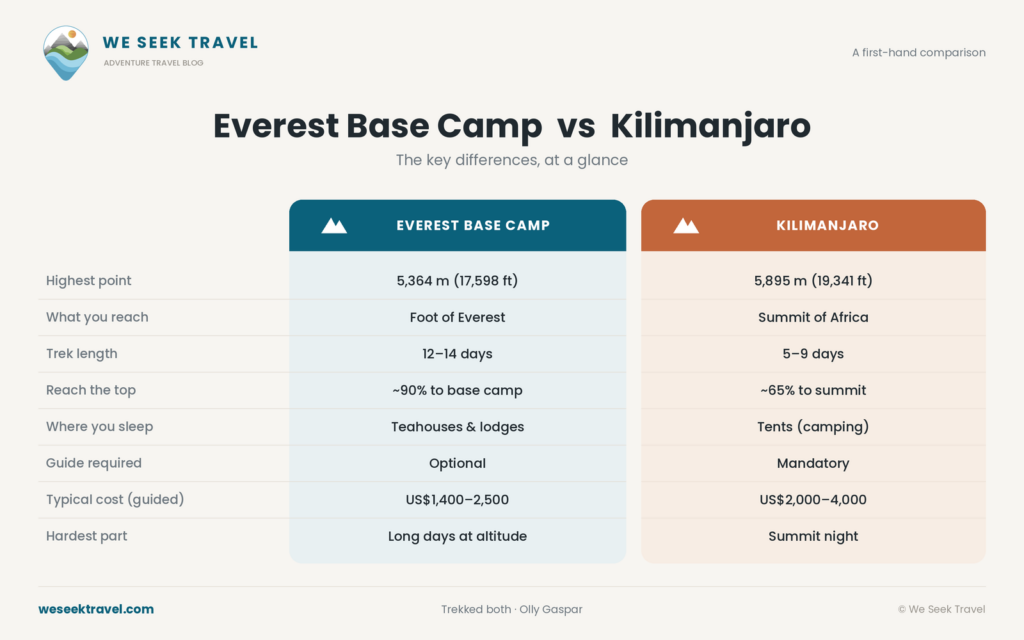
This is a completely different feeling and really the first thing to consider. Below are some useful stats comparing EBC to Kili.


Is Everest Base Camp Higher Than Kilimanjaro?
No. Kilimanjaro is higher. Its summit, Uhuru Peak, sits at 5,895 m (19,341 ft), while Everest Base Camp tops out at 5,364 m (17,598 ft). That makes Kilimanjaro about 531 m (1,743 ft) higher than the point you reach on the EBC trek.
The name trips people up. Everest is the highest mountain on Earth, so anything with "Everest" in the title feels like it should win. But you don't summit Everest on this trek. You walk to its base camp, which sits lower than the top of Kilimanjaro, a mountain you actually climb all the way up.
That said, if you are trekking to EBC, I'd highly recommend climbing the nearby viewpoint at Kala Patthar for a clear view of Everest (since you can't see the peak from base camp). If you do, this would be the highest point on the EBC trek at 5,644 meters (18,519 ft), still considerably lower than Kilimanjaro.


Why Altitude Profile Matters
The actual altitude number is the least useful part, though in my experience.
What you feel up there has far more to do with how fast you got there. Kilimanjaro asks you to gain more height in five to nine days, while Everest Base Camp spreads a smaller daily climb across about two weeks, with rest days built in at Namche Bazaar and Dingboche.
Both made me feel the altitude. The difference was how much time my body had to adjust, and that is exactly why Kili has the bigger reputation for altitude sickness. I get into why in the next section.


What Are the Success Rates? (Will You Actually Make It?)
Roughly 90% of trekkers reach Everest Base Camp, against a Kilimanjaro average somewhere around 65% across all routes.
Before you read too much into that gap, know that the two numbers measure different things. Reaching Everest Base Camp means arriving at a point on a trail. Summiting Kilimanjaro means standing on the actual top of the mountain after the hardest night of the trip.
They are not quite like for like.
On both treks, the thing that turns people back is almost never fitness. It is altitude. Acute mountain sickness causes around 60% of Kilimanjaro failures, and it has little respect for how strong you are. Plenty of marathon runners climb too fast, too sure of themselves, and end up worse off than the steady plodders behind them.
The part you can control on Kilimanjaro is your route. Short five-day climbs summit as little as 27% of the time, because there is simply no room to acclimatize. Stretch the same mountain over eight or nine days and your odds jump above 90%. I trekked the eight-day Lemosho route for exactly that reason, and the extra days made the summit feel achievable rather than brutal.
This is roughly how Kilimanjaro success rates stack up by trek length:
| Kilimanjaro route length | Approx. summit success |
|---|---|
| 5 days | ~27% |
| 6–7 days | ~50–65% |
| 8 days (e.g. Lemosho) | ~85–90% |
| 9 days (Northern Circuit) | ~95% |
Figures are approximate and vary by operator and season.
Everest Base Camp posts high completion rates for the same reason the long Kili routes do. The standard 12 to 14 day itinerary has acclimatization built in, with rest days at Namche Bazaar and Dingboche that quietly do the work. You can't really pick a faster or slower EBC the way you do on Kili, so most people who start it finish it.
Insurance for EBC & Kilimanjaro
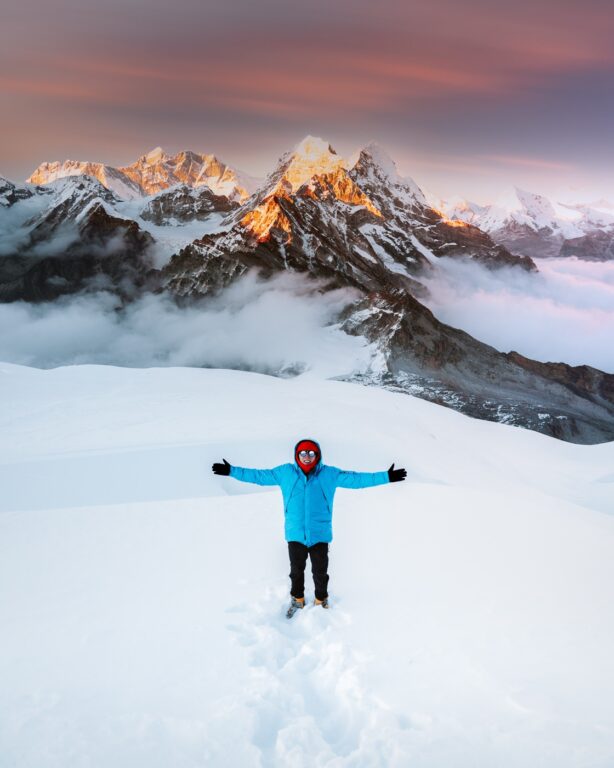
Read the fine print– Most travel insurance companies void coverage as soon as you step over 5,000 m. That's why I use and recommend Global Rescue, as the best high-altitude trekking insurance (no altitude caps). I personally used this for both EBC and Kilimanjaro
Which Is Harder, Everest Base Camp or Kilimanjaro?
Honestly, they are closer than people expect. Both are non-technical treks at serious altitude, and neither is a stroll. To better answer this question, here's my experience on the parts that can be considered "hard".
Summit night (Kilimanjaro's crux)
Kili saves its worst for last. You leave camp around midnight and climb roughly 1,200 m (3,900 ft) of dark, frozen scree to reach Uhuru Peak near sunrise. It is cold, slow, and mentally draining, and it is the single hardest thing on either trek. Everest Base Camp has no equivalent. You walk in on an established trail.

Time on your feet
Everest Base Camp is the longer grind. You trek for 12 to 14 days, with several big days climbing in and out of valleys. Kilimanjaro crams everything into five to nine days, so it is sharper but over sooner. Neither is hard because of the walking itself. The altitude is what makes ordinary days feel heavy.

Where you sleep
This one quietly matters. On Everest Base Camp you sleep in teahouses, with a real bed, a dining room, and a stove to thaw out beside. On Kilimanjaro you camp the whole way, in a tent, in the cold. Better rest makes the long EBC days far easier to back up.


Underfoot
Both trails are well-trodden and easy to follow, with no scrambling or ropes. Kilimanjaro is a steady uphill grind that finishes on loose, ankle-rolling scree. Everest Base Camp is rockier and more up-and-down, with long climbs like the steep haul to Namche Bazaar and a few high suspension bridges that test anyone wary of heights.

How remote it feels
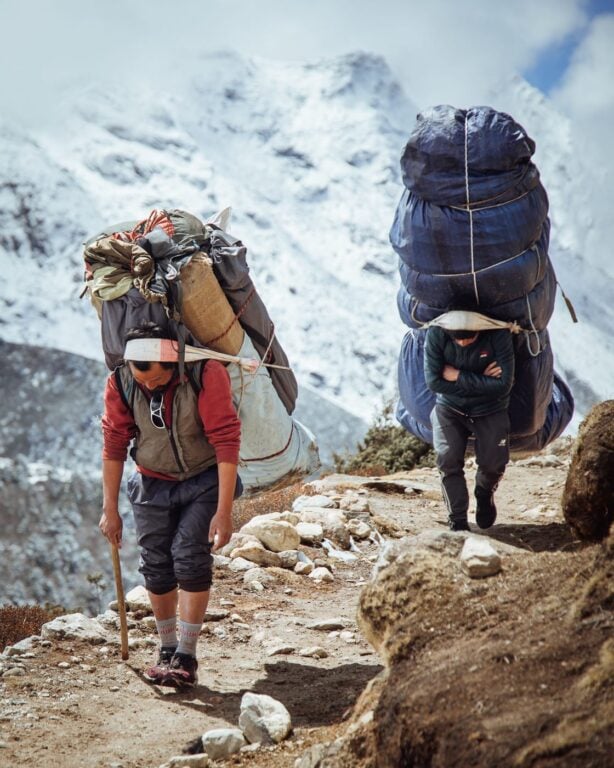
For all the altitude, Everest Base Camp never feels truly cut off. You move village to village through the Khumbu, eating and sleeping in lodges that are already there, with shops, bakeries, and the odd cafe along the trail.
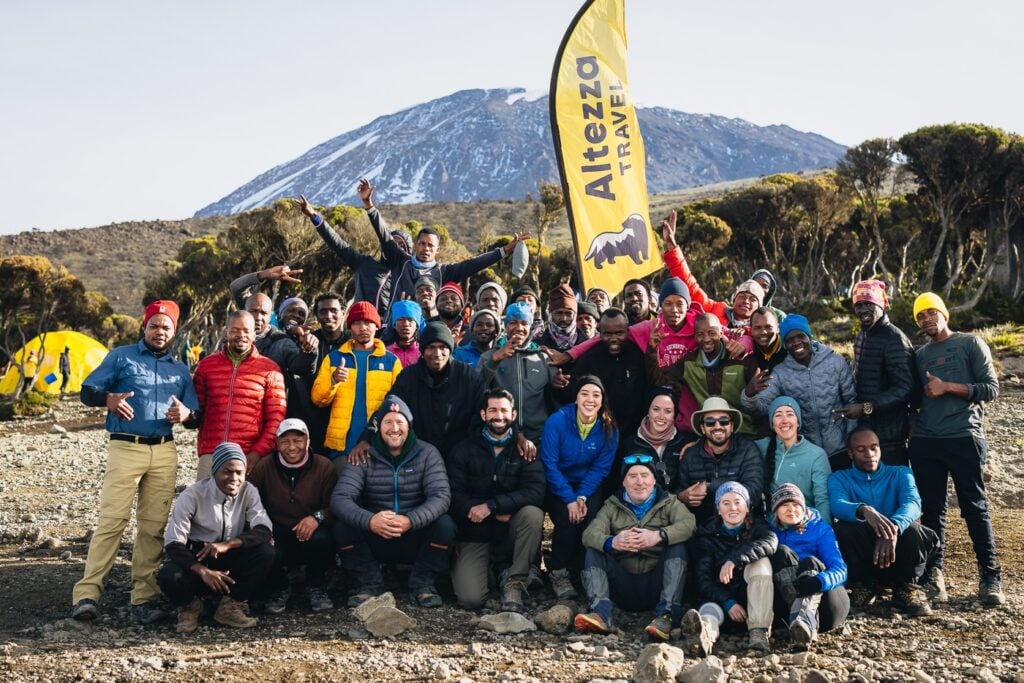
Kilimanjaro is the opposite. Once you pass the park gate you are in a self-contained bubble, with a team of porters hauling your tents, food, and mess tent up and down the mountain. There are no villages to duck into, so everything you use has to be carried in for you. It feels more like a proper expedition, even though it is the shorter trek.


How Much Does Each Trek Cost?
No matter how you look at it, Kilimanjaro is more expensive than Everest Base Camp. There is not much you can do about it. More than half of what you pay goes straight to the park in fixed fees: a conservation fee of US$70 per person per day, nightly camping fees, a rescue fee, and 18% VAT on top.
Add a guide and porter crew that is required by law, and a typical climb lands between US$2,000 and US$4,000. There is no real budget version, because the biggest costs are not optional.
Everest Base Camp is cheaper and far more flexible. Permits total around US$60, teahouses run a few dollars a night, and you only pay for what you use. You can trek it independently for roughly US$1,000 to US$1,400, or join a guided package for US$1,400 to US$2,500. The cost that catches people out is the flight to Lukla, which runs US$350 to US$420 round trip and is often quoted separately. It is also why EBC can be done on a shoestring while Kilimanjaro cannot, though more on trekking solo below.
Tip: I use and recommend Himalayan Masters for any trek in Nepal. Mention We Seek Travel for 5% off your entire trip (which is quite a handy saving).
| Everest Base Camp | Kilimanjaro | |
|---|---|---|
| Typical guided cost | US$1,400–2,500 | US$2,000–4,000 |
| Cheapest realistic option | ~US$1,000–1,400 (independent) | None, a guide is required |
| Permits / park fees | ~US$60 total | ~US$900–1,300 (50–60% of the cost) |
| Flights to the trailhead | Lukla flight, US$350–420 round trip | Usually a road transfer, included |
| Guide & porters | Optional | Mandatory |

Can You Trek Either One Independently?
Short answer: you can trek Everest Base Camp on your own, but you cannot climb Kilimanjaro without a guide.
Kilimanjaro has required every climber to have a licensed guide since 1991. It applies to every route, every season, and everyone, with no exceptions for experience or nationality. Turn up without a registered crew and you will be stopped at the gate, and you can be fined US$1,000 to US$2,000. The rule exists to fund the park, protect local jobs, and keep people alive on a mountain where altitude sickness is common.
Everest Base Camp is different. You can legally trek it independently. The Khumbu Pasang Lhamu Rural Municipality, the authority that actually governs the Everest region, allows solo trekkers, whatever the on-and-off debate about guide rules at the national level. All you need are two permits, the Sagarmatha National Park entry and the local Khumbu permit, which together cost around US$60 and can be sorted in Kathmandu or Lukla.
Should you go solo on EBC? You can, and plenty do. The trail is well-established, easy to follow, and lined with teahouses, so navigation is rarely the problem. That said, a guide or a porter-guide takes the logistics off your plate, adds a safety net at altitude, and puts money straight into the local economy. I would not call it essential on this trek, but it is rarely money wasted.
So, Everest Base Camp or Kilimanjaro? My Honest Verdict
After doing both, my real answer is that they are too different to crown a winner. Both are beautiful. Both are also busy, more commercialized every year, and that crowding chips away at some of what drew people to them in the first place.
If you want to pair your trek with a safari, walk through genuinely varied terrain, climb up through the forests, spot wildlife, sleep in expedition tents and share dinners in a mess tent, and stand on the highest point in Africa, go for Kilimanjaro.
If you want Sherpa culture, the tallest mountains on Earth all around you, teahouse life each evening, and the slow beauty of the Nepali Himalaya, go for Everest Base Camp.
But here is where I will push you a little. Both trails are crowded enough now that I would happily point you somewhere quieter. In Africa, Mount Kenya is a wilder, lonelier climb, and Uganda's Rwenzori Mountains are about as remote as trekking gets.
In Nepal, I have trekked all over the Khumbu, and if you want Everest views without the main-trail traffic, the Gokyo Lakes or the Three Passes are better walks than the standard base camp route. And if you want my favorite trekking region anywhere, it is the Manaslu Circuit.
Quieter, rawer, and still everything I love about Nepal.
Whichever you pick, you are in for a great trek. Just go in with your eyes open, choose the route that fits the trip you actually want, and book enough days to enjoy it.