

JamboSim is a new budget travel eSIM covering 200+ countries, with 10 GB plans for Europe, the US and China at just less than $10 a pop. To find out whether cheap can still be reliable, I put it through the toughest test I can think of for an eSIM: a 14-hour layover in Beijing on my first ever trip into mainland China.
China is a country where you need a connection to do almost anything – Google, WhatsApp and Instagram are blocked on local networks, cash is close to useless, and almost everything from taxis to dumplings runs through an app on your phone.
I’ve been traveling full-time for eight years and have tested a long list of travel eSIMs, so I knew exactly what I wanted from this one. I bought JamboSim’s China plan while I was still on a trip in Mongolia, switched it on as my plane rolled into Beijing, and used it for everything from DiDi and Alipay to finding Peking duck south of Tiananmen Square.
Disclosure: I bought the eSIM and tested it myself in China, and the findings and opinions below are my own. You can read more in our publishing principles.

My TL;DR Review
JamboSim is one of the cheapest eSIMs I've tested: 10 GB for 30 days costs US$9.99 in Europe, the US and China, and hotspot is allowed on every plan. I tested it in China, where it connected on the runway, ran on fast, consistent 5G and let me use Instagram and WhatsApp without a VPN.
The app is one of the simpler ones I've used. The catch is that JamboSim is a very new brand with strict refund rules and email-only support, so it suits travelers who are comfortable installing an eSIM themselves. Luckily that's not too hard...
How I Tested JamboSim
I used it on an iPhone 15 Pro running the latest version of iOS. The plan was JamboSim's China eSIM with 10 GB of data valid for 30 days, which cost me A$14.99 (the same plan shows as US$9.99 in US dollars). That's far more data than one day needs, but I wanted headroom for maps, uploads and anything else China threw at me.
On the Mongolia part of the trip I'd been testing Orbit Mobile. In Beijing, JamboSim was the only eSIM I used for data, from the moment I landed until I flew out.

What Is JamboSim, and Is It Legit?
JamboSim is a legitimate eSIM reseller run by Goomla B.V., a registered company based in Almere, in the Netherlands. Like most travel eSIM brands, it doesn't own any cell towers. It buys data from local networks around the world and sells it to you as an eSIM you install on your phone, which is how travel eSIMs work in general.
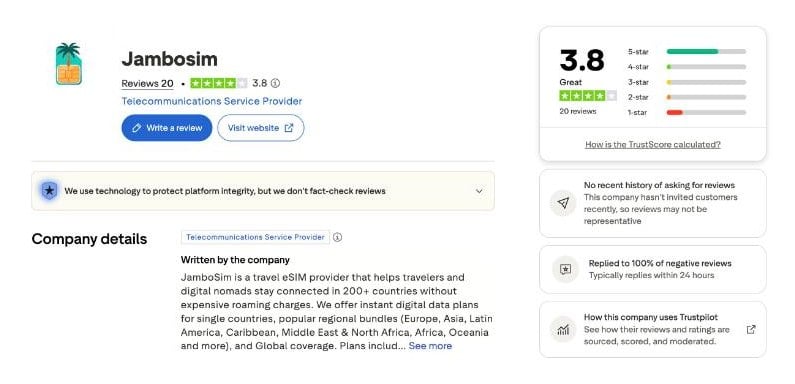
It's also one of the newest eSIM brands I've tested. The website, the iPhone app and the Android app have only been around for a few months, so there's not much of a track record yet. On Trustpilot it sat at 3.8 out of 5 from around 20 reviews when I checked, which is a small sample either way.
JamboSim Prices, Plans & Where It Works
JamboSim says it covers 200+ countries, and its Global plan page lists 199 of them. You'll see a few different numbers around its website (125+, 157 and 168 all appear on different plan cards), so check your destination directly before you buy.
Every country has two types of plan: fixed data packs, from 500 MB up to 100 GB, and unlimited day passes from three to 30 days. You can pay by card, Apple Pay, Google Pay and a few local wallets, and the site shows prices in more than ten currencies.
JamboSim Prices for Popular Destinations
To me, JamboSim's pricing is where it stands out. A 10 GB plan valid for 30 days costs under US$10 in most of the places I'd expect readers to be heading, and its regional Europe and Asia plans cost about the same as a single country. These are the prices I saw in US dollars:
| Destination | 10 GB / 30 days | Unlimited, 7 days | Network |
|---|---|---|---|
| Europe (41 countries) | US$9.99 | US$16.99 | Local partners in each country |
| United States | US$9.99 | US$16.99 | T-Mobile / Verizon |
| Japan | US$7.99 | US$12.99 | SoftBank / KDDI |
| Thailand | US$6.99 | US$11.99 | True / AIS |
| Asia (18 countries) | US$7.99 | US$11.99 | Local partners in each country |
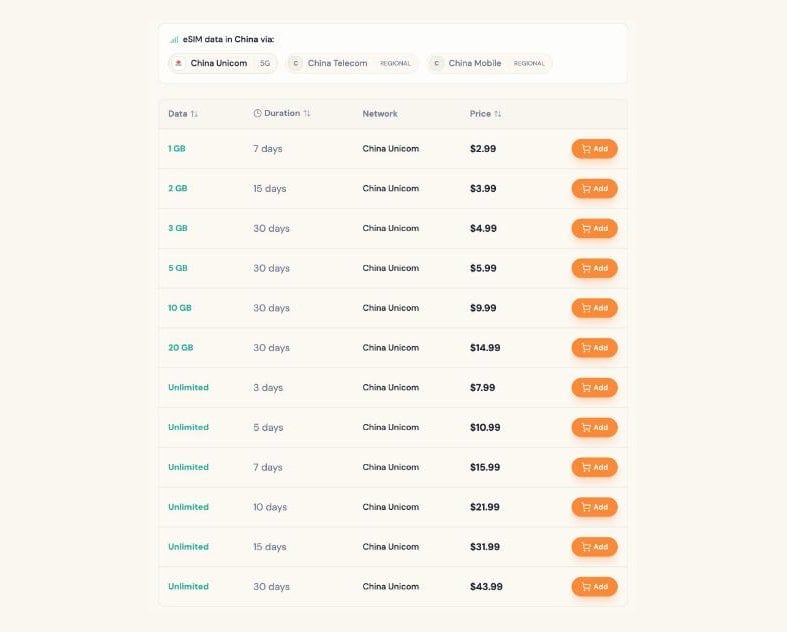
| China | US$9.99 | US$15.99 | China Unicom 5G |
| Global (199 countries) | US$25.99 | No unlimited option | Varies |
JamboSim's prices change depending on where you're buying from. JamboSim is a Dutch company, and its prices include European VAT where it has to charge it, so the same China plan can look noticeably more expensive if you're shopping from Europe (about 21% more in the checks I ran).
For context, Airalo's Europe plan was around US$20 for just 5 GB when I last compared it in my Holafly vs Airalo comparison. If you're on a multi-country trip through Europe, my guide to getting internet in Europe without roaming fees explains how regional eSIMs work at the border.
JamboSim China eSIM Prices
All of JamboSim's China plans run on China Unicom's 5G network, and you can top up from the app. This is the full China plan list as I saw it in US dollars:
Fixed Data or Unlimited? The 3 GB a Day Rule
JamboSim's unlimited plans give you 3 GB of full-speed data per day. After that, your speed drops to about 1 Mbps until midnight local time, then resets. That's enough for messaging and maps, but slow for video calls or uploads.
The fixed data packs don't have a daily cap at all, so you can burn through 6 GB in an afternoon if you want to. That's the main reason I picked one for China.
The part I like most: JamboSim says hotspot is allowed on every plan with no restrictions. Most "unlimited" eSIMs I've used cap tethering, and Holafly's hotspot allowance is usually somewhere between 500 MB and 1 GB a day, which is tight if you work from a laptop like I do.
Tip: Compare a fixed data pack against the unlimited plan for your trip length before you buy. For China, 10 GB for 30 days cost less than three days of unlimited. See plans: JamboSim China eSIM
Setting Up JamboSim: My Experience
Setting up JamboSim took me a few minutes in Mongolia and zero effort in China. You'll need to create a free account to buy, which I did in the app, and then everything lives in one place.
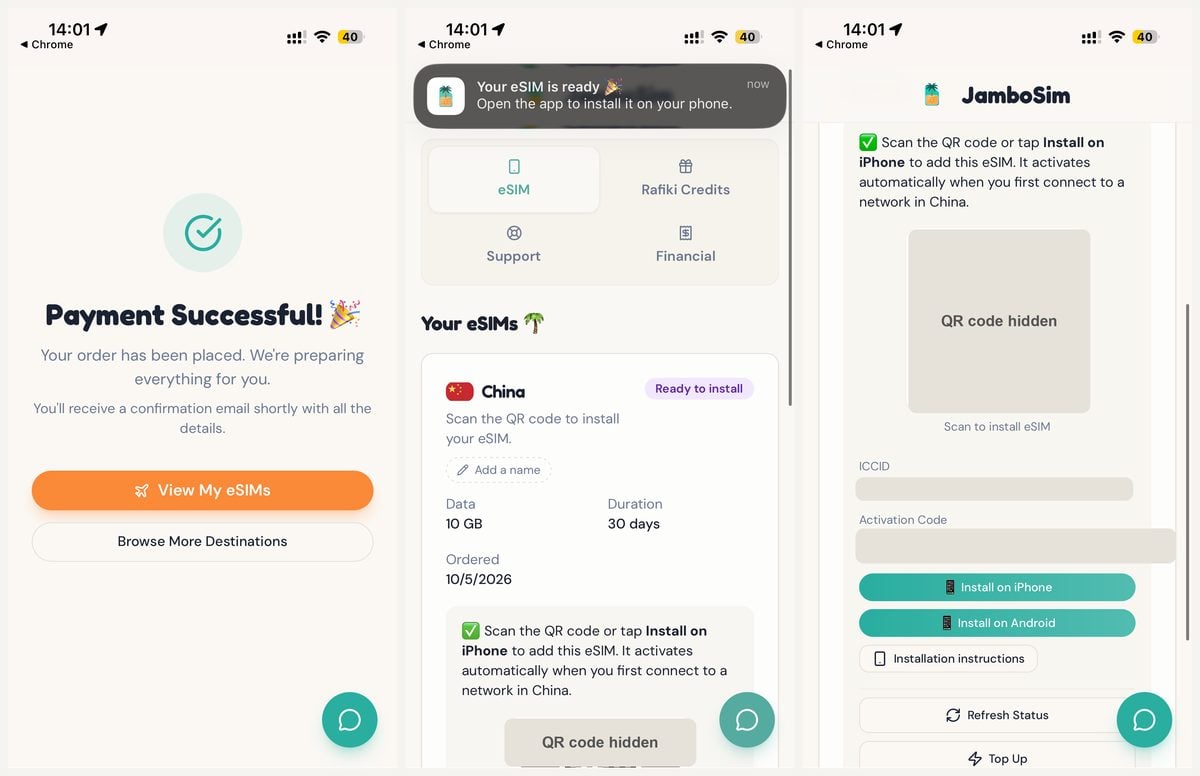
- Buy the plan. I picked China, chose the 10 GB / 30 day pack and paid in the app. The "Payment Successful" screen came up straight away, followed by a notification that my eSIM was ready.
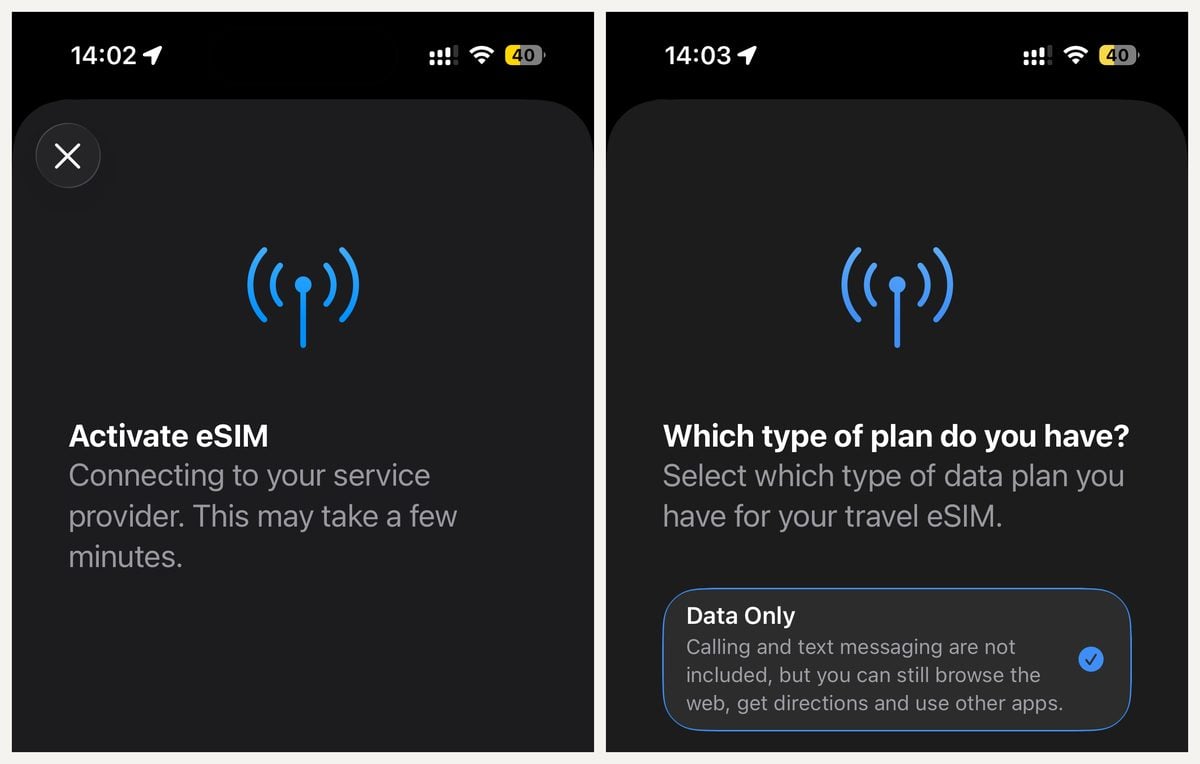
- Install the eSIM. Under My eSIMs, the China eSIM showed as "Ready to install", with an Install on iPhone button. One tap opened the iPhone's own eSIM setup, which asked me to confirm it was a data-only plan. There's also a QR code and a manual code if you're installing on a second device.
- Label it and set your lines. As always, I kept my home number as the default line for calls and texts, set JamboSim for mobile data, and turned off "Allow Mobile Data Switching" so I wouldn't roam on my home SIM by accident.
- Leave data roaming on for the JamboSim line. It's a roaming eSIM, so it won't connect in China if roaming is switched off.
- Wait until you land. The app says the plan activates automatically the first time your phone connects to a network in China, so the 30 days didn't start counting down in Mongolia.
The best bit came on arrival. I was still on the runway at Beijing when I switched off airplane mode, and the eSIM connected straight away. No restarting, no flicking airplane mode on and off, no toggling the eSIM a few times until it caught a network. It's the first eSIM that's ever done that for me.
Two warnings before you buy. JamboSim's eSIM locks to the phone you install it on, and if you delete the profile, you can't reinstall it. Also check your phone isn't carrier locked before you pay, because that's the most common reason eSIMs fail to install.
Does JamboSim Work in China Without a VPN?
Yes. In my experience, JamboSim worked in China without a VPN. Meta's apps (Instagram, WhatsApp and Facebook) and every other Western app I opened worked normally on JamboSim data, and I never switched a VPN on during the whole layover.
The reason is how travel eSIMs route your data. A Chinese SIM card sits behind the Great Firewall, which blocks most Western apps. A roaming eSIM like JamboSim connects to China Unicom's towers, but your traffic is sent back out through a network outside mainland China, so the apps behave as if you were browsing from overseas.

Oddly, JamboSim's own China page still says a VPN is essential. Its blog says the opposite, and my experience matched the blog. Keep in mind that China's filtering changes, so no eSIM company can promise every app will work every day. If something is mission-critical for you, it's worth having a VPN installed as a backup before you fly, since VPN sites are blocked once you're there.
14 Hours in Beijing on JamboSim
I used JamboSim for the whole layover: getting out of the airport, planning the day on the fly, paying for everything and getting back for my flight. In China, having data on your phone is essential if you want to do anything. China is largely cashless now, Beijing especially, and almost everything runs on Alipay or WeChat Pay.
From the Airport to the City with DiDi
I left the airport Wi-Fi behind without a second thought and booked a DiDi into the city on JamboSim data. DiDi is China's version of Uber, and I booked it inside Alipay rather than downloading a separate app, which was advice from a Chinese friend before the trip.
Paying for Everything with Alipay
I paid for every single thing in Beijing with Alipay: my rides, metro trips, food and the drink at the end of the night. Every payment needs a data connection, so the eSIM was doing the heavy lifting all day, and it didn't drop out once.

Foreign cards now work in Alipay, and payments of ¥200 (about US$28) or less don't carry a fee. Above that, Alipay charges 3% of the whole payment. I set Alipay up before I flew, which I'd recommend to anyone, whether or not you're using JamboSim (more on why below).
Tiananmen Square, Qianmen Street and the Metro
I spent the afternoon around Tiananmen Square, using the eSIM to read up on what I was looking at as I walked. Then I headed to the street just south of the square for the famous Peking duck.

From there, I walked down to the metro and rode across to the China World Trade Center in the CBD. I went up to the top for the views over the city at night, ate dinner in the building and had a drink downstairs before heading back to Capital Airport.
The Beijing Subway accepts Alipay through a Metro QR code you scan at the gates, so there's no need to buy tickets with cash. Without data, that QR code doesn't load, which is another reason not to rely on Wi-Fi in China.
JamboSim Speed and Coverage in Beijing
JamboSim's speeds in Beijing were very fast and consistent. I was on 5G all day, from the runway to Tiananmen Square and the top of the China World Trade Center.

Keep in mind I only tested JamboSim in central Beijing, which has some of the best mobile coverage in the world. I can't speak for rural China, but since JamboSim runs on China Unicom, coverage should be similar to what a local on that network would get.

JamboSim vs Holafly vs Airalo
For trips of three days or more, JamboSim was the cheapest unlimited China eSIM I priced. For a single day, Holafly wins, because JamboSim doesn't sell a one-day China plan. Note, I'm comparing China as this was the testing location for this eSIM.
| China plan | JamboSim | Holafly | Airalo | Nomad |
|---|---|---|---|---|
| 1 day | No 1-day plan (1 GB / 7 days: US$2.99) | Unlimited: US$3.90 | No 1-day plan (1 GB / 3 days: US$4.00) | No 1-day plan (1 GB / 7 days: US$4.00) |
| 3 days unlimited | US$7.99 | US$11.90 | US$11.50 | US$12.00 |
| 7 days unlimited | US$15.99 | US$27.50 | US$27.00 | US$25.00 |
| Network | China Unicom 5G | Varies | China Unicom | Varies |
| Says no VPN needed? | Yes on its blog, no on its China page (worked without one for me) | Yes | Yes | Yes |
Choose JamboSim if you're in China for three days or more, want unlimited or a big data pack for less, or need an uncapped hotspot for a laptop.
Choose Holafly if you only need a single day, or you'd rather stick with a brand that has years of reviews behind it. I've used Holafly across Europe and Asia, and you can read why in my Holafly vs Airalo comparison.
Choose Airalo if you already use it elsewhere and want everything in one app. It's the most widely known name, but it cost more than JamboSim for every China unlimited plan I compared.
The JamboSim App: Two Things I Liked
I'm usually not a fan of downloading a separate app for every eSIM, and I've said as much in my Europe eSIM guide. To be honest, JamboSim's app was simple and easy to use, and I'd put it among the better ones I've tried, alongside Orbit Mobile and Truely.
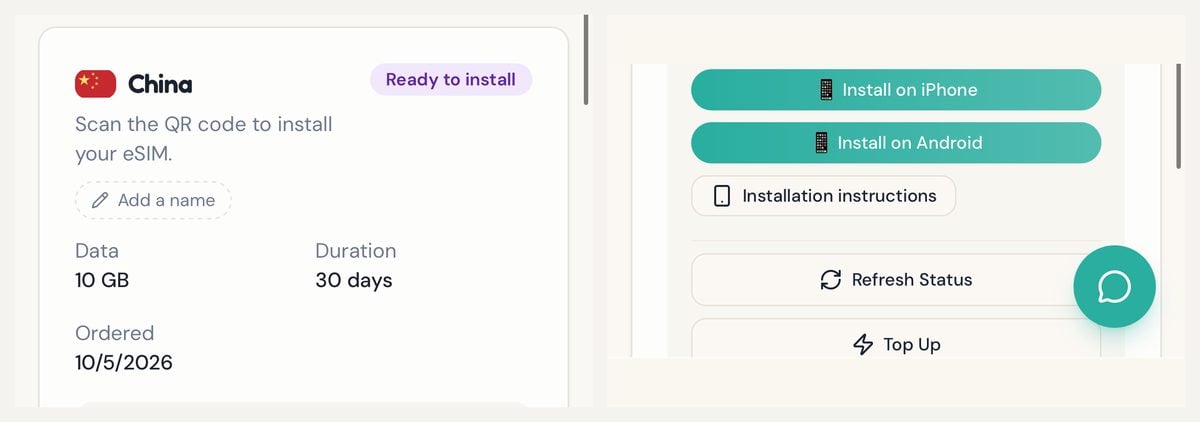
1. One tap from purchase to installed. The "Install on iPhone" button sits right on the eSIM card, and it handed me straight to the iPhone's own setup screen. The app also told me in plain words that the plan would activate when I first connected in China, so I knew I could install it days early without wasting any of the 30 days.
2. Everything for your eSIM on one screen. Data, duration and order date sit on the same card, along with a button to name the eSIM, a Refresh Status button, a Top Up button and a support chat bubble that follows you around. With Jetpac's app, I couldn't even find the search bar at first.
What I'd Change About JamboSim
JamboSim did everything I needed in China, but there are a few things I'd want fixed before I'd call it a sure bet:
- Strict refunds. You only get a refund if the eSIM fails to install and support can't fix it, you're charged twice, or it never arrives. Once it's installed, there's no refund, even if coverage is poor, and requests have to come within 30 days of purchase.
- No phone support. Help comes from an AI chat called JamboBot and an email address that aims to reply within 24 hours. I didn't need either, but it's thinner support than the big brands offer.
- No one-day China plan. The smallest China pack is 1 GB for seven days, which is cheap, but a true one-day option would suit layovers better.
- Top-ups restart the clock. A top-up replaces your remaining days instead of adding to them, so eight days left plus a 15-day top-up gives you 15 days, not 23.
- Data only. Most plans have no phone number, so you can't receive SMS codes. Keep your home SIM active for those.
Is JamboSim Worth It?
Yes, especially if price matters to you. JamboSim's plans undercut most of the big names I've used, from Europe and the US to Asia, and it passed the hardest test I could give it. In China, it got me online the second I switched off airplane mode, kept me on fast 5G across Beijing, and let me use every app I needed, Western and Chinese, without a VPN. Overall, it was a flawless experience.

I'd recommend it for budget travelers who want a big data pack for less, anyone who tethers a laptop and is sick of hotspot caps, and especially for China and the rest of Asia. I'd think twice if you only need a single day in China (Holafly's one-day plan is cheaper and simpler), or if you'd rather pay a little more for a brand with years of reviews and a phone line. For other options, see my roundup of the best eSIMs for travel.
Tip: Buy and install your eSIM at home on Wi-Fi, and leave data roaming on for that line so it connects the moment you land. Get it: JamboSim eSIM
Frequently Asked Questions
Is JamboSim legit?
Yes. JamboSim is run by Goomla B.V., a registered Dutch company, and it resells data from local networks like any other travel eSIM brand. It's very new, with a 3.8 Trustpilot score from around 20 reviews when I checked, but my China eSIM installed in one tap and worked all day in Beijing.
Does JamboSim work in China without a VPN?
In my experience, yes. On a 14-hour layover in Beijing, Instagram, WhatsApp, Facebook and every other Western app I opened worked on JamboSim's China eSIM without a VPN, because the data is routed outside mainland China. Filtering can change, so install a VPN at home as a backup if you rely on one particular app.
When does a JamboSim plan start?
Your plan starts the first time your phone connects to a mobile network in your destination, not when you buy or install it. I installed my China eSIM in Mongolia before I flew, and the 30 days only started when I switched off airplane mode on the runway in Beijing.
Can I use JamboSim as a hotspot?
Yes. JamboSim says hotspot and tethering are allowed on every plan with no restrictions. Fixed data packs have no daily cap, while unlimited plans drop to about 1 Mbps after 3 GB of full-speed data each day, so pick a fixed pack if you plan to work from a laptop.