

I’ve used both Holafly and Airalo across more than a dozen countries over seven years of full-time travel. Below I’ll break down pricing, actual speed test results from Bali and Lombok, and which eSIM Ipersonally keep buying and why.
When I first started traveling full-time back in 2018, buying a local SIM card was one of the first things I did in every new country, usually from an airport kiosk or the Alfamart or 7/Eleven closest to my hostel.
Fast forward seven years of full time travel, and getting a SIM card is still one of my first logistical steps when I arrive in a new country. However, now I can tick this one off while waiting for the airplane seatbelt light to switch off.
eSIMs have gone from being expensive and niche to becoming one of the most practical tools for international travelers. I used to avoid them since they were more expensive than local SIMs. But, with more competition, prices have dropped, data speeds have improved, and package options now range from regional bundles to unlimited global coverage.
In this guide, I’ll provide a fair and unbiased comparison of Holafly vs Airalo—two of the best travel eSIMs available at the moment. I’ve personally used and recommended both of these across destinations in Southeast Asia, Europe, and beyond and below I’ll explain which I continue to use where, and why.
Quick Take: Which eSIM Should Most Travelers Pick?

My TL;DR Comparison:
Both Holafly & Airalo eSIMs offer near identical availability, speeds, ease-of-use, and phone compatibility.
Previously, Holafly had the upper hand with their unlimited plans. Now, Airalo also offers unlimited plans in many regions, so the gap between the two products is even narrower.
For longer trips and heavy data use, Holafly is my personal favorite. For short trips or budget-conscious travelers, Airalo's per-GB or unlimited plans are now a competitive alternative.
Save 5% on any Holafly package with code WESEEKTRAVEL.
Wait Before You Buy! How eSIMs Work
First things first: an eSIM is a digital SIM card in your phone. Instead of inserting a physical SIM, you scan a QR code or download an app to activate your package, you don't need anything physical, besides your phone.
That’s it, no swapping SIMs at the airport, no hunting for local stores.
Sounds simple, right? It is as long as your phone supports it. This is the single most important step. Holafly has a phone compatibility tool on its website and app. Use this before buying anything. Almost all eSIM companies make refunds impossible if your phone isn’t compatible.
In fact, nearly all the negative reviews I’ve read, for both Holafly and Airalo, come from travelers who tried to use an eSIM on an unsupported device and were unable to get a refund since these kinds of companies have very limited customer service (still better than a standard telcom provider).
So check first, save yourself a headache, and only then move on to picking your package!

Holafly vs Airalo: Quick Comparison
| Feature | Airalo | Holafly |
|---|---|---|
| Countries Covered | 200+ | 200+ |
| Package Types | 1) Fixed data (1GB to 50GB+) or 2) unlimited data plans from 3 days to 30 days | 1) Unlimited plan with daily, monthly, or custom durations. 2) A "light" plan - global usage with 25 GB data per month |
| Pricing | 1) Daily per GB 2) Daily unlimited Price varies per country. | 1) Daily unlimited (varies per country) 2) Monthly global unlimited or 25 GB plans 3) Yearly global unlimited or 25 GB/month plans |
| Global plan available? | Yes (called "Discover+") | Yes |
| Hotspot | Yes | Yes |
| Throttling/Speed | May vary by destination; often lowered rate of 1 Mbps after 3 GB usage per day. Clearly spelled out when purchasing unlimited plans. | Speed may reduce after heavy usage per local carrier fair use policy (less clearly disclosed than Airalo's policy) |
| Activation Process | QR scan or app install | QR scan or app install |
| Great for: | Budget, light users (maps/email); short trips; frequent top-ups | High data users (streaming/work); longer trips; multi-country travel |
The key difference that I've noticed between Holafly and Airalo comes down to data structure and flexibility. As of 2026, the two products are more alike, as Airalo has started offering unlimited packages.
Holafly continues to offer unlimited data packages that you can personalize for the amount of days that you need (from 1 to 90 days), while Airalo sells both unlimited and capped data packages that range from 1 GB to 50 GB, depending on the country.
Also new for 2026 are Holafly's options for a global "light" monthly package, capped at 25 GB per month, and the yearly packages of unlimited or light global coverage. Holafly’s model is ideal for long-term travelers and digital nomads who use a lot of data, for example, navigating, hotspotting, or posting travel photos. It's great if you want the convenience of not tracking usage.
Airalo, on the other hand, feels more like buying a local SIM directly from your phone. It’s often the cheaper option if you only need light data for maps, messaging, or occasional browsing. The trade-off should you choose a capped package is that you’ll need to monitor your usage and top up if you run out.
Overall, Holafly prioritizes simplicity and ease, while Airalo offers cost efficiency. The best choice depends on how much data you actually use while traveling.
Holafly vs Airalo: Price Comparison
The pricing landscape between these two has shifted significantly in 2026. Holafly continues to lead with unlimited plans, but Airalo now offers both capped and unlimited options across many regions.
On a recent trip to Indonesia, I compared both providers to see how this plays out in practice.
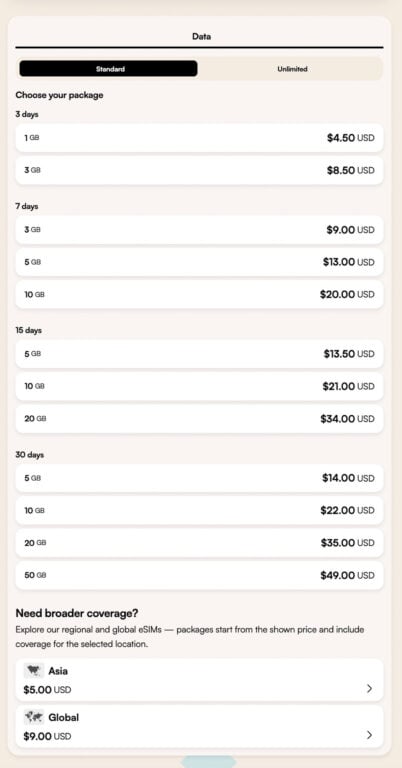
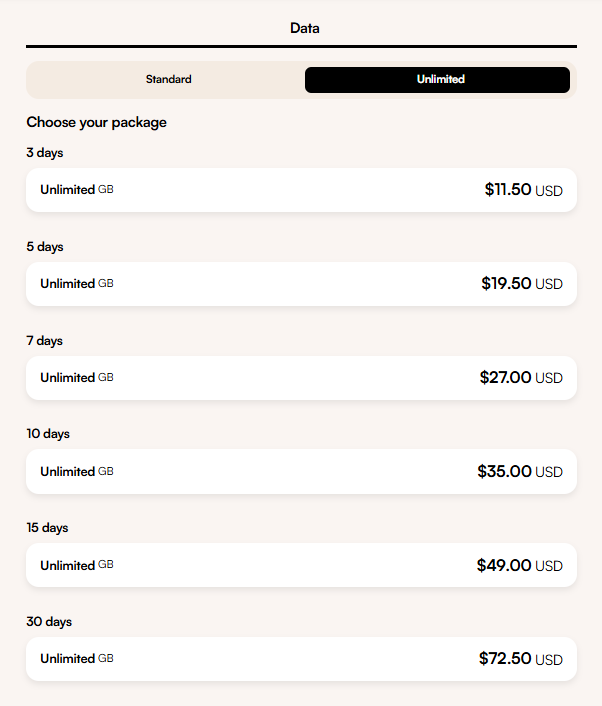
Airalo offers local Indonesian eSIMs starting around $4–$5 for 1–2 GB, with larger bundles of 5–20 GB going for roughly $13–$35, depending on the length of validity. Their unlimited packages start around $11 for 3 days and go up to $72 for a full month.
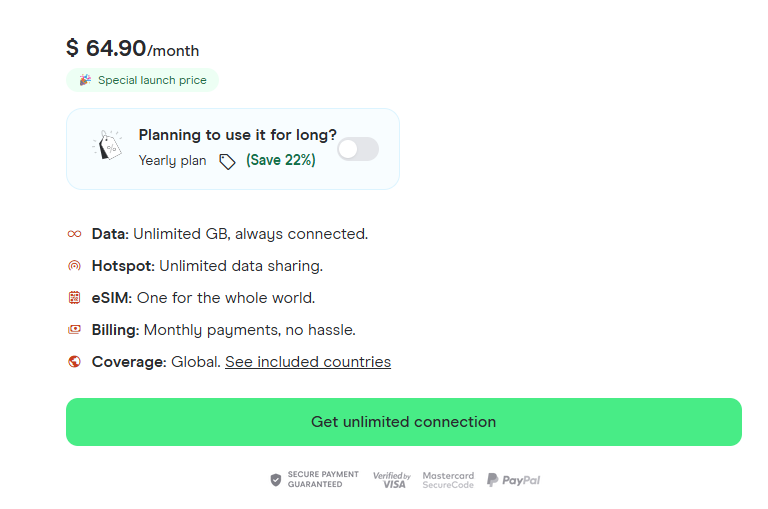
Holafly, in contrast, sells travel eSIM data packages ranging from US $6.90 for 1 day up to US $75.90 for 30 days - essentially comparable to the pricing of Airalo's unlimited plan. However - if you are traveling for a full month, you'll definitely want to take a look at Holafly's monthly plans. A global monthly unlimited plan runs $65 at the time of this update, and includes Indonesia. (Be sure to double check the included countries in the global plan before you purchase.)
I was a bit surprised at how expensive both options were for Indonesia, given how cheap local SIMs can be. That made me curious to check out regions known for higher data costs, where I’ve personally used both Airalo and Holafly in the past.
In Europe, Airalo’s regional packages start at about $5 for 1 GB/3 days, with 5 GB/30-day packages around $20, and 20 GB/30-day packages roughly $49.
Airalo's 10 day unlimited Europe regional plan is $35, while Holafly's 10 day package is currently around $37. In my opinion and experience using SIM cards while traveling, Holafly always offered more value for money, but for the average traveler, the two products are much more neck-and-neck these days.
Holafly vs Airalo: Coverage & Performance
Coverage and performance really vary by country and region, it is a SIM after all, and is completely tied to local tower availability. However, if you read my note at the start on how eSIMs work, then you already know that which provider the eSIM connects to is critical, because it determines connectivity, coverage, and performance.
Again, if you’re traveling to remote places with no cell reception, you can’t expect an eSIM to work. No SIM, digital or physical, will provide coverage where towers don’t exist. So if you’re heading to remote regions like the Himalayas or Karakoram, you won’t get service no matter which eSIM you buy.
To give a fair comparison based on my experience, here’s the coverage I got while using Holafly and Airalo in Bali and Lombok.
In my experience, island-hopping around Bali and Lombok, connections remained consistently usable in tourist hubs like Denpasar and Ubud. Holafly provided strong 4G/5G coverage on Bali’s most reliable networks (Telkomsel, Indosat). Some remote spots, like when I was hiking Rinjani, didn’t have coverage at all on either eSIM, or even on my friends' local physical SIMs for that matter.
Comparing performance, I was able to get slightly faster speeds with Holafly, consistently exceeding 50 MB/s in the main tourist areas of Bali. That said, Holafly was throttled after about 3 GB of daily usage, causing slight slowdowns, but it remained very usable for maps, messaging, and browsing.
2026 Update: Now that Airalo also offers unlimited plans, speed throttling is also seen with Airalo, also usually after 3 GB. What's nice about purchasing an Airalo unlimited plan is the Fair Use Policy regarding when your speed will slow down is very transparent before you complete your purchase. Holafly's policy is a bit more vague.

Holafly vs Airalo: Usability & Customer Support
In terms of usability, both Holafly and Airalo are extremely easy to use. You simply scan a QR code or download an app, then follow the setup process. I tested this on an iPhone 15 Pro, and it worked flawlessly, but I’ve also installed both eSIMs on an older iPhone 11 with no issues. I don’t have personal experience with Android devices, but both companies say the process is very similar.

Comparing usability, I’d say they’re essentially equal. Their apps are well-designed, but personally, I prefer not to install extra apps unless necessary. Both platforms allow you to download and install the eSIM without the app, which is a bonus. That said, if you want to track data usage, you’ll need the app, although with Holafly’s unlimited packages, that’s not necessary.
If you’ve read my Holafly review, you’ll know I had a great experience using their eSIM on a long road trip. However, that post generated many comments from users reporting that the SIM didn’t work and that getting a refund was difficult. In most cases, I noticed the complaints in the comment section came down to phone compatibility, so it’s crucial to check whether your device supports eSIMs before buying.
I haven’t personally had to contact customer support for either company, so I can’t comment firsthand on responsiveness. That said, Holafly’s main complaint seems to be that some users couldn’t get a response or a refund when the SIM didn’t work. If they want to continue building a strong brand for an excellent product, improving support and refund processes is key.
Though overall, Holafly currently has a 4.6 rating on Trustpilot (with over 87,000 reviews), while Airalo has a score of 3.9 with around 23,000 reviews at the time of review.
Airalo reviews show a similar pattern: users who had trouble installing the eSIM often found it difficult or impossible to get a refund. Unfortunately, this seems to be a common pain point across both platforms, which is frustrating for travelers who expect a seamless experience.

Final Verdict: Which is the Best Travel eSIM?
After testing both, Holafly is my personal favorite. For travelers like me who work online, stream, upload content, and move between countries, the simplicity of unlimited data makes life so much easier. I don’t have to monitor usage, worry about topping up mid-trip, or switch eSIMs when crossing borders.
That said, the gap between the two has narrowed significantly in 2026. Airalo's new unlimited plans are now competitive on price (but Holafly still tends to be cheaper when it comes to the longer duration plans), and their fair use policy is more transparent at the point of purchase than Holafly's. If you're on a shorter trip or budget is the priority, Airalo is a much stronger option than it used to be.
Take home message:
Heavy data user on a long trip → Holafly.
Short trip or budget priority → Airalo.
Want travel perks like lounge access on top of connectivity → check out Jetpac.
If you want to try out Holafly, don't forget to use our code WESEEKTRAVEL for 5% off on any purchase.
Frequently Asked Questions
Is Holafly or Airalo cheaper?
Airalo is cheaper up front for per GB plans. When it comes to unlimited plans, the longer plans (i.e., 30 days or more), Holafly tends to be cheaper. If thinking of an unlimited plan and price is a big factor for you, I recommend comparing both for your destination.
Can I use Holafly and Airalo as a hotspot?
Both support hotspot, but Holafly limits tethering to 500MB–1GB per day depending on the plan and destination. Airalo's hotspot availability varies by plan, so check before buying.
Which is better for digital nomads?
Holafly, especially with their new monthly and annual plans that offer a significant discount. The longer term, unlimited data structure removes the need to monitor usage, which matters when you're relying on connectivity for video calls, uploads, and remote work across multiple countries.
Do both eSIMs work on Android?
Yes, both work on Android and iOS. Both companies confirm the setup process is similar across device types.
What happens if my eSIM doesn't work?
Both companies have limited refund policies. Refunds are typically only available for device incompatibility confirmed within 30 days. Always use the phone compatibility checker before purchasing — this is the most common reason for negative reviews on both platforms. Even if your phone is compatible, you could have a block on eSIM installation from your cellular carrier if your phone is financed.