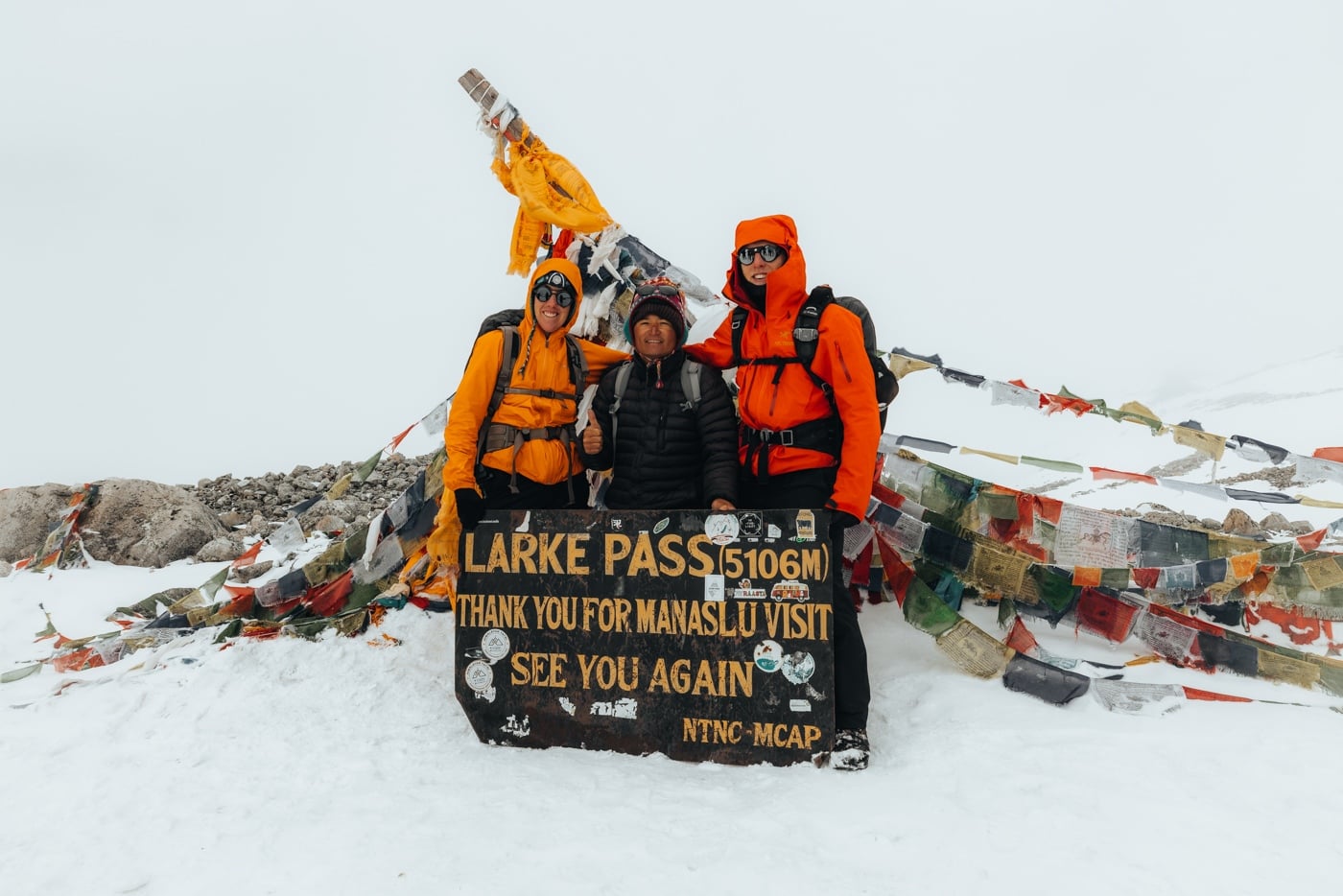


The Manaslu Circuit and Everest Base Camp are both world-class Himalayan treks – but they’re not really competing for the same trekker.
EBC is the most iconic trail on earth. The Khumbu is spectacular, the Sherpa culture is moving, and walking under the shadow of the world’s highest peaks never gets old. But it also attracts over 60,000 trekkers a year, and that volume changes the experience in ways that are hard to ignore.
Manaslu feels like what the Khumbu probably looked like before it became the Khumbu, that is, fewer crowds, more basic teahouses, deeper cultural immersion, and a sense of remoteness that’s increasingly hard to find in Nepal. I did the Everest region first on the Three Passes Trek and have returned several times since for climbs including Mera Peak and Island Peak. I did the Manaslu Circuit later with a licensed guide (now mandatory), and the difference hit me within the first day on the trail.
This post breaks down the real differences in crowds, cost, culture, difficulty, teahouses, permits, and views – so you can figure out which trek is right for you.
Manaslu Circuit vs Everest Base Camp: Key Differences at a Glance
The Manaslu Circuit is a 175 km restricted-area loop requiring a mandatory licensed guide, crossing the Larkya La Pass at 5,106 m (16,752 ft) with roughly 10,000 trekkers per year. Everest Base Camp is a 130 km out-and-back on Nepal's busiest trail and you can still (in 2026 hike without a guide. There's also significantly better infrastructure at every stage.
Here's a quick reference table comparing the Manaslu vs Everest treks.
| Manaslu Circuit | Everest Base Camp | |
|---|---|---|
| Distance | 175 km (109 mi) | ~130 km (81 mi) |
| Duration | 13–15 days from Kathmandu | 12–16 days from Kathmandu |
| High Point | Larkya La Pass 5,106 m (16,752 ft) | Kala Patthar 5,643 m (18,514 ft) |
| Avg Distance Per Day | ~13 km (8 mi) | ~10 km (6 mi) |
| Difficulty | Moderate–Strenuous | Moderate |
| Guide Required | Yes & mandatory by law | No (Khumbu region exempted) |
| Teahouse Quality | Basic but comfortable | Developed (Wi-Fi, hot showers, espresso) |
| Starting Altitude | ~700 m (2,297 ft) — Soti Khola | ~2,860 m (9,383 ft) — Lukla |
| Total Altitude Gain | ~4,400 m (14,436 ft) | ~2,800 m (9,186 ft) |
| Annual Trekkers | ~10,000 | 60,000+ |
| Total Cost | US$900–$1,600 | US$1,250–$2,700 |
| Best For | Remote wilderness, cultural immersion | Iconic Everest views, easier hiking infrastructure |
Insurance for Trekking & Climbing in Nepal
Read the fine print– Most travel insurance companies void coverage as soon as you step over 5,000 m. That's why I use and recommend Global Rescue, as the best high-altitude trekking insurance (no altitude caps).
The Regional Difference: Khumbu vs Manaslu Conservation Area
EBC runs through Sagarmatha National Park in the Khumbu, Nepal's most famous trekking corridor. The Manaslu Circuit is a restricted-area route through the Manaslu Conservation Area, roughly 150 km to the west, with its own permit system and a mandatory licensed guide.
The two regions share almost nothing beyond altitude.
The Khumbu
The Sherpa people have lived here for centuries, and their culture is woven into every part of the EBC trail. The monastery at Tengboche is one of the oldest and most significant in the region. The weekend market in Namche Bazaar, where families from surrounding villages still come down to trade, has been running long before trekking tourism existed here.
The infrastructure reflects the footfall. With over 60,000 trekkers a year, most lodges from Namche upward offer hot showers, espresso, and satellite Wi-Fi.

The Manaslu Region
The communities on the Manaslu Circuit are Nupri people, descendants of Tibetan immigrants who settled the upper Budhi Gandaki valley in the early 1600s. Their Tibetan Buddhist traditions and language have stayed largely intact, partly because the region remained restricted and isolated long after the Khumbu opened up.
The gompas feel older and less visited. When I did the optional side trip to the Tibetan border above Samdo at 5,030 m (16,503 ft), we had the entire ridge to ourselves. That kind of silence is genuinely hard to find on the EBC trail at any point during peak season.

Practical Details: Cost & Permits
Both EBC and Manaslu treks require planning in Kathmandu before you set foot on the trail. Though the key difference in my experience is that Manaslu is much stricter than the Khumbu and requires the most forward planning. To trek in the Khumbu you can pay all permits once you actually arrive.
Permits
Manaslu Circuit: I recommend asking your tour / agency to organize all fees for you.
| Permit | Cost | Where to Get |
|---|---|---|
| Restricted Area Permit | US$75 (spring) / US$100 (autumn) | Kathmandu via licensed agency |
| Manaslu Conservation Area Permit | NPR 3,000 (~US$22) | Kathmandu or Jagat checkpoint |
| Annapurna Conservation Area Permit | NPR 3,000 (~US$22) | Kathmandu or Dharapani |
| Total permits | ~US$119–144 |
2026 update: Nepal removed the rule requiring two foreign trekkers before a solo permit would be issued. You can now get a solo permit. A licensed guide is still mandatory regardless.
Everest Base Camp: You can pay for both of these once you arrive:
| Permit | Cost | Where to Get |
|---|---|---|
| Sagarmatha National Park Entry | NPR 3,000 (~US$22) | Monjo checkpoint or Kathmandu |
| Khumbu Pasang Lhamu Municipal Fee | NPR 2,000 (~US$15) | Lukla checkpoint |
| Total permits | ~US$37 |
While EBC permits are significantly cheaper. The costs stack up elsewhere.
Tip: Regardless of whether you choose Everest Base Camp or Manalsu Circuit, you'll want to get high altitude trekking insurance which is getting more and more difficult and complex. I've written individual guides for insurance for Manaslu Circuit, compared to insurance for EBC here.

Cost
The real cost difference between Everest Base Camp and Manaslu Circuit trek is the Lukla flight and the premium teahouse prices on the busiest trail in Nepal.
Manaslu Circuit
- Return jeep to trailhead: ~US$30–50 each way
- Teahouses: ~US$8–15 per night
- Food on trail: ~US$15–20 per day
- Guide (mandatory): included in most agency packages
- Total: roughly US$900 - $1,600 total
Everest Base Camp
- Return Lukla flight (from Ramechhap in peak season): ~US$180–200 per leg
- Teahouses: ~US$10–20 per night, higher at altitude
- Food on trail: ~US$20–30 per day
- Guide: optional but recommended
- Total: roughly US$1,250–$2,700 all-in
For both treks, I book through Himalayan Masters a really high quality local agency run out of Thamel that offers competitive all-in packages and pays their guides and porters above the standard rate. You can use OLLY5 for 5% off any trek.

Getting to the Trailhead
The access stories for these two treks are completely different, and it's one of the more underrated differences between them.
Everest Base Camp: Fly to Lukla
You get to the EBC trailhead by flying into Lukla, a small mountain airstrip at 9,383 feet in the Khumbu valley. The flight from Kathmandu takes about 35 minutes and costs roughly $180–$220 one way.
One important caveat for spring trekkers: during April and May, most Lukla flights depart from Ramechhap airport, not Kathmandu. That means a 4–5 hour drive from Kathmandu (leaving at 3–4am) before you even board the plane. Factor that into your first day!
Technically you can walk from Jiri to Lukla instead of flying — it's the old-school route. But it adds 7–8 days of trekking before the trail even starts feeling like "EBC." Given the cost of the flight is roughly the same as a week of teahouse accommodation, most people fly. I'd recommend the same.

Manaslu Circuit: Drive to the Trailhead
There's no flight option for Manaslu. You get there by road from Kathmandu to Soti Khola or Maccha Khola, the standard trailheads on the circuit's southern end.
The drive takes 7–8 hours by private jeep, or up to 12 hours by local bus. Most agencies include a private jeep in the package price - in my opinion that's the move. The road gets rough in the final stretch and the bus is exhausting. I did it with Himalayan Masters in a private jeep, and even that was a solid day's work before the trail started (it is very long, and the road is very sketchy at times).
Budget around $80–$120 for a shared jeep, or it's often included if you've booked through an agency.
The bottom line: EBC has the more dramatic (and slightly nerve-wracking) access with the Lukla flight. Manaslu is just a long road day. Neither is complicated, but both are worth planning around — don't treat them as throwaway travel days.

EBC: The Base Camp and Kala Patthar
Here's something you might not know before you go: Everest Base Camp itself is not the visual highlight of the trek.
When you get there, you're standing on the Khumbu Glacier at 17,598 feet, surrounded by rocks and ice and a cluster of expedition tents. There's no clear view of Everest's summit from base camp beacuse the mountain is too close and the angles don't work. It's still an incredible moment, but more of a "I made it here" feeling than a "wow, look at that" feeling.
Kala Patthar is where you get the views. It sits at Kala Patthar 5,643 m (18,514 ft) above the village of Gorak Shep, and on a clear morning it gives you one of the best above-ground views of Everest anywhere on the planet. Most people summit it pre-dawn for sunrise. It's cold, it's dark, and it's absolutely worth it. If you're pressed for time or weather turns bad, Kala Patthar matters more than base camp.
My honest take: the entire Khumbu valley is spectacular. The walk through Namche Bazaar, the views of Ama Dablam, the feel of the high altitude Sherpa villages - the journey is the highlight, not just the endpoint.

Manaslu: Larkya La and the Tibetan Border
The centerpiece of the Manaslu Circuit is crossing Larkya La Pass at 5,106m / 16,752ft. You leave Dharmasala before dawn (usually 3–4am), climb in the dark with headlamps, and arrive at the top as the light hits the surrounding peaks. The views from the pass including Manaslu itself, Himlung, Cheo Himal, are stunning, and you share them with maybe a dozen other trekkers rather than a hundred you'd come across at EBC.
The descent into Bimthang on the other side is one of the best single trekking days I've had anywhere. Wide open valley, the entire south face of Manaslu ahead of you, rhododendrons in bloom if you're there in spring. It's one of those days where you just feel lucky.
But the moment that stuck with me most an unplanned and optional detour near the northern section of the circuit. This was a side trail that takes you up toward the Tibetan border. You're in this stripped-back high altitude landscape leading to a fenced border with Tibet. There's something about the remoteness of that spot that the EBC trail can't replicate. It's not on most itineraries and your guide needs to know it exists but if you're doing Manaslu, ask about it.


Difficulty: Two Types of Hard
Most people who've done both will tell you Manaslu is harder. They're right, but the reason might not be what you think.
EBC: Altitude Accumulation
EBC doesn't have one brutal day. What it has is sustained altitude exposure. On the EBC you spend 8 or 9 days above 11,500 feet, and your body is constantly working to recover overnight. The trail itself is well-maintained and the gradients are manageable. But by the time you're pushing up to Kala Patthar at 18,514 feet, the cumulative fatigue is real.
The biggest physical risk on EBC realistically is AMS (acute mountain sickness) from ascending too fast on a trail that makes it tempting to push. The well-worn path and good teahouse infrastructure mean people underestimate how high they're going.

Manaslu: Terrain and the Pass Day
Manaslu is harder on your body daily. The trail is rougher, the daily stages are longer (6–8 hours most days vs 4–6 on EBC), and you're doing it on significantly less teahouse comfort and food variety. The trail isn't always obvious and sections can involve loose rock, river crossings, and steep terrain without the well-trodden path you get in the Khumbu.
Then there's the Larkya La day. You leave Dharmasala at 3–4am, climb in the dark for several hours, cross the 16,752-foot pass, and descend to Bimthang. It's a 10–12 hour day at high altitude with potential ice and snow on the pass itself. It's the hardest single day I've had on any trek in Nepal.
There's also no real bail-out on Manaslu. On EBC, if something goes wrong, you're on a busy trail with helicopters and lodges everywhere. On Manaslu you're in a restricted area with sparse infrastructure. That changes the mental calculus.
My honest verdict: If you've never trekked at altitude before, EBC is the right call. The infrastructure catches you if things go wrong, and the altitude challenge alone is enough for a first Himalayan trek. Manaslu is a much more raw experience if you're only going to do one and don't want to be left with a sour taste in your mouth about the "business" opt for the slightly harder Manaslu trek.

Which Trek Is Right for You?
Both are genuinely great treks and after doing both, here is my recommendation if you have to pick between EBC and Manaslu Circuit:
Choose EBC if: You want the most iconic Himalayan experience on earth, you're newer to altitude trekking, or you want solid infrastructure while still being in the high Himalaya. The Khumbu valley is spectacular, the Sherpa culture is amazing, and walking toward the world's tallest mountain never really gets old. The crowds are real, but so is the experience (for now).

Choose Manaslu if: You want something rawer. Fewer people on the trail, teahouses that feel more like someone's home than a guesthouse (because they are), and Buddhist villages that haven't been reshaped around tourism the way parts of the Khumbu have. The Manaslu region is genuinely beautiful, the upper Budhi Gandaki valley, the Tibetan-influenced culture around Samagaun, the approach to Larkya La, and you'll share most of it with almost no one. It's comfortable enough, but it'll ask more of you.

A note for serious trekkers: If you've already done EBC and you're wondering what's next, I'd skip straight to the Everest Three Passes Trek rather than treating Manaslu as the natural step up. The Three Passes gives you the Khumbu with a real mountaineering edge including three passes above 5,300m, remote valleys, and a higher level of challenge.
After that, trekking peaks like Mera Peak or Island Peak are the natural progression if you want to start moving from trekking into actual climbing. Both are accessible without a full mountaineering background and both are among the best experiences I've had in Nepal.
Manaslu sits in its own category it's not really a step up from EBC so much as a completely different type of trip. If what you're after is remote, beautiful, culturally rich, and still within the comfort of teahouse trekking, it's hard to beat.