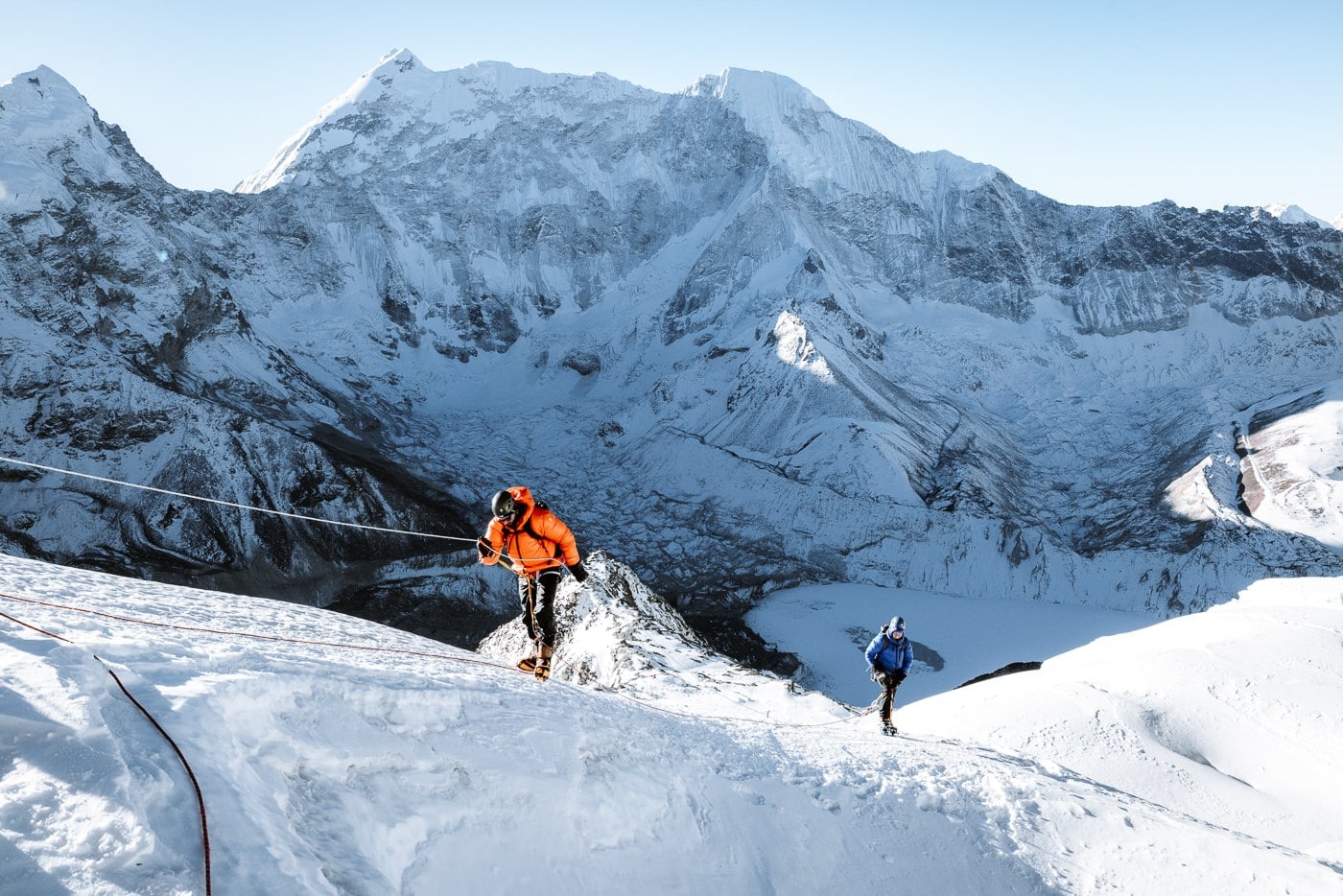


Climbing a Himalayan peak above 6,000 m is the key entry point into Himalayan mountaineering, and this was a huge goal of mine for many years since first hiking in the Khumbu. After now climbing both peaks, I’ve written this post to help other aspiring climbers weigh up between Island Peak and Mera Peak.
While they are often grouped together as “trekking peaks,” the experience on the mountains are totally different in many ways, from the approach trek to the technical skills required for the summit.
In this post, I’ll break down the key differences between Island Peak and Mera Peak based on my first-hand experience to help you decide which Himalayan peak fits your goals.
Overview: Mera Peak vs Island Peak
If I could answer the question of the difference of Mera Peak and Island Peak in one sentence it would be that Mera is a much more remote trekking peak with the main challenge of the climb being the altitude, while Island Peak's approach offers much better infrastructure while the most difficult section is the semi-technical wall to the summit.
Mera Peak is the highest trekking peak in Nepal at 6,476 m (21,247 ft). It is a long, cold "plod" across a massive glacier. The summit is a few hundred meters higher, which means A LOT at this altitude. The most essential thing is good cardiovascular fitness but you'll need zero technical climbing skills.
Island Peak or Imja Tse, stands at 6,189 m (20,305 ft) and sits in the heart of the Khumbu. While also a long day to the summit, the summit altitude is less, though the biggest challenge is the 100 m headwall of ice and the narrow, exposed ridge just before the summit. This requires fixed ropes and Jumar use.
| Island Peak (Imja Tse) | Mera Peak | |
| Summit Elevation | 6,189 m (20,305 ft) | 6,476 m (21,247 ft) |
| Technical Grade | Alpine PD+ (Moderate Technical) | Alpine PD (Non-Technical) |
| Difficult Part | 100 m headwall (45–50°) & exposed ridge | Pure altitude, cold, and a long glacier slog |
| Required Skills | Jumar, Rappelling, Fixed Ropes | Crampon walking, basic Ice Axe use (dependent on your guide) |
| Altitude Profile | Punchy technical finish; lower altitude | Sustained high altitude; higher peak |
| Itinerary Length | 14–16 Days (from KTM) | 16–20 Days (from KTM) |
| Cost | $2,500 – $4,500 USD | $2,200 – $3,500 USD |
| Accommodation | Developed tea houses (EBC Trail) | Remote lodges & High Camp camping |
| High Camp Altitude | 5,500 m (18,044 ft) — Optional | 5,800 m (19,029 ft) — Mandatory |
| Best For | Aspiring mountaineers wanting technical skills | Trekkers wanting a major altitude milestone |
Below I'll dive into more of the key differences and some insights I found out on the treks.
The Regional Difference
Island Peak: The Khumbu Region
Island Peak (Imja Tse) is located in the Khumbu Valley within Sagarmatha National Park. This is the heart of the "Everest Region." The mountain is an extension of the Lhotse Shar ridge and is surrounded by the iconic 8,000 m giants (Everest, Lhotse).
The infrastructure here is highly developed (and getting more developed every year) because it shares the main Everest Base Camp trekking trail. This is the first region I trekked in Nepal on the Three Passes Trek, and if you climb Island Peak you can even combine the trek with the EBC or Three Passes optionally.

Mera Peak: The Hinku Valley (Makalu-Barun)
Mera Peak is located in the Hinku Valley, which sits within the Makalu-Barun National Park.
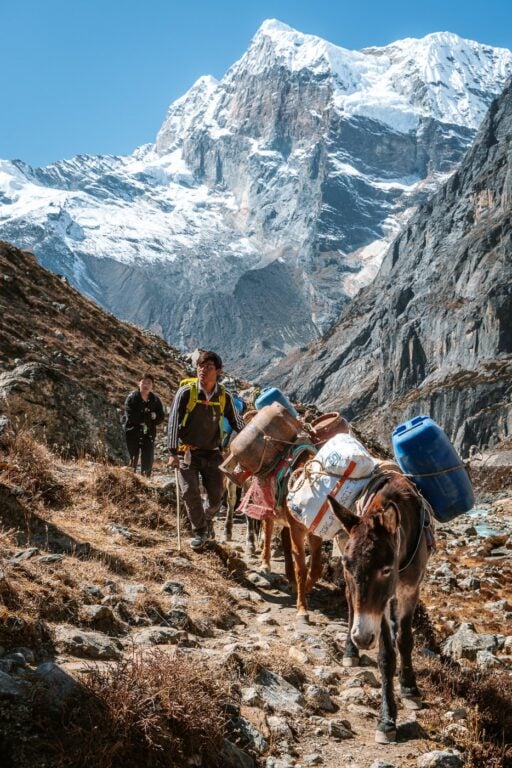
While it is south of Everest, it is considered a remote wilderness area. The approach through the Hinku is far less developed than the Khumbu. It is geographically separated from the Everest Base Camp trail by high ridges, which is why you have to choose a specific approach, either the Zatrwa La pass from Lukla or the southern route from Bung (I did the latter).
Logistics, Permits & Guide Rules
Navigating the logistics for these two peaks has changed significantly in recent years.
When I climbed Mera Peak a couple of years ago, you could trek independently in this region and hire a guide at Khare - and this is what I did. However, there are now new regulations which mandate licensed guides for almost all high altitude routes leading to the summit. Below is the current situation.
The Mandatory Guide Rule
As of 2026, the Nepal Tourism Board strictly enforces a "No Guide, No Trek" policy for foreign nationals. HOWEVER, the local municipality in the Khumbu have pushed back on this for years.
- Mera Peak: A licensed guide is compulsory for the entire duration of the trek and climb. You now cannot legally enter the Hinku Valley or attempt the summit without being registered through a trekking agency.
- Island Peak: This one is tricky as the Khumbu region has historically pushed back against mandatory trekking guides for the past few years. As of 2026, you can still technically hike all the way to Chhukung without a guide. However, a climbing guide is legally required for the summit portion of Island Peak (can be arranged in Chhukung lodge).
Tip: These days I personally arrange all my climbs and expeditions in Nepal with Sandip from Himalayan Masters. They are a local, professional, and affordable team that provides expert Sherpa guides. Booking with a local agency like this ensures your money stays within the Nepali community rather than going to a massive international operator.

Climbing Insurance
Any reputable operator will require proof of high-altitude insurance before you step on the mountain. I’ve written detailed guides to both Insurance for Island Peak and Insurance for Mera Peak, but the core requirement is the same for both.
Because both peaks exceed 6,000 m (19,685 ft), your policy must explicitly cover "mountaineering" or "peaks up to 6,500 m." Standard travel insurance almost always caps coverage at 4,000 m (13,123 ft), which is useless for these climbs.
You specifically need a plan that covers emergency helicopter evacuation from remote regions, as in when I did the research private rescue can cost between $3,000 and $10,000 USD out of pocket.
I currently use Global Rescue myself. They are widely considered the most reliable for high-altitude field rescues and are currently the most affordable option for 6,000 m+ peaks.
Important Note: Global Rescue is a rescue membership, not traditional travel insurance. It covers the cost of getting you off the mountain and to a hospital, but it does not cover hospital bills, flight cancellations, or stolen gear. You should look into your own options here though I usually pair this with a standard policy like IMG.

Permit Fees
Permit costs vary by season, with Spring (March–May) being the most expensive due to stable weather and higher success rates.
Island Peak (Imja Tse):
- NMA Climbing Permit: $250 (Spring) / $125 (Autumn).
- Where to pay: This must be issued in Kathmandu by the Nepal Mountaineering Association (NMA). Your agency (like Himalayan Masters) will handle this before you arrive.
- Sagarmatha National Park Fee: NPR 3,000 (~$23 USD).
- Where to pay: You can pay this at the National Park office in Kathmandu or at the park entrance gate in Monjo.
- Khumbu Pasang Lhamu Fee: NPR 3,000 (~$23 USD).
- Where to pay: This is a local government tax. It is only payable in Lukla or Monjo. You cannot get this in Kathmandu.
- Garbage Deposit: $500 (Refundable per team). Paid in Kathmandu to the NMA.

Mera Peak:
- NMA Climbing Permit: $250 (Spring) / $125 (Autumn).
- Where to pay: Must be arranged in Kathmandu via a registered agency.
- Makalu-Barun National Park Fee: NPR 3,000 (~$23 USD).
- Where to pay: You can pay this at the park office in Kathmandu or at the checkpoint in Kothe as you enter the Hinku Valley.
- Local Entry Fee: NPR 2,000 (~$15 USD).
- Where to pay: Typically paid on the trail in Kothe.
- E-TIMS Registration: NPR 2,000 (~$15 USD). This is now processed digitally by your agency in Kathmandu.
Note: I recommend discussing directly with your trekking company to arrange all permits and entry fees in advance to save hassle as in my experience, Nepal is constantly changing requirements and prices.

The Approach
The approach is where the main difference in the entire experience diverges in my opinion. Here's a breakdown.
Island Peak: The Khumbu Highway
The trek to Island Peak is straightforward and follows the primary Everest Base Camp (EBC) artery. After the notorious flight to Lukla 2,840 m (9,318 ft), you follow a well-maintained trail through Namche Bazaar, Tengboche, and Dingboche.
For Island Peak, the primary staging point is the village of Chhukung 4,730 m (15,518 ft). It typically takes 6 to 8 days of trekking from Lukla to reach this point, including mandatory acclimatization days in Namche Bazaar and Dingboche.
From Chhukung, you trek about 3 hours to Island Peak Base Camp 5,087 m (16,690 ft). Most modern expeditions (like the one I did with Epic) spend one night here for skills training, practicing Jumar and abseiling, before starting the summit push at 1:00 AM the following morning.
The infrastructure here is the best in Nepal. I stayed in comfortable lodges like Bhodi Lodge and Chhukung Resort, which offer hot showers, reliable Wi-Fi, and even espresso machines. The distance from Lukla to Chhukung is approximately 35 km (22 miles), and because the trail is so busy, you are never far from help or a decent meal.

Mera Peak: The Wild Journey to Khare
Getting to Khare 4,900 m (16,076 ft), the final village before Mera Peak, is significantly more complex than the standard out and back route to Island Peak.
While there are several alternatives, you generally have two ways to start, and I highly recommend the "loop" approach we did for better acclimatization and a less repetitive experience.
- The Southern Start (My Recommendation): I began this route with a 12-hour jeep ride from Kathmandu to Bung Mahakulung 1,700 m (5,577 ft). The car ride is brutal and bumpy, but we really enjoyed trekking through the lower, non-touristy villages like Khiraule Gompa and seeing the holy lakes of Panch Pokhari 4,350 m (14,272 ft). This route allows you to complete the trek in a loop, finishing with a flight down from Lukla after the climb.
- The Lukla Shortcut (Zatrwa La): You fly to Lukla and immediately climb the 4,610 m (15,125 ft) Zatrwa La pass. While faster, this jump is physically punishing and carries a much higher risk of altitude sickness early in the trip.
It takes 8 to 11 days to reach the staging point of Khare via the southern route.

Difficulty
Both mountains are physically demanding and will be the hardest thing you’ve ever done if you haven’t trekked above 6,000 m (19,685 ft). However, in the global context of mountaineering, these are "entry-level" peaks. Compared to technical 4,000 m classics in the Alps (like the Matterhorn) or the North American Rockies, the actual climbing moves are straightforward and don't require much if any mountaineering experience (hence the term trekking peak).
Mera Peak
The main difficulty of Mera Peak is, by far, the altitude. The climb itself is technically just a steady glacier trek. When I climbed, there were no fixed ropes; it’s a long, slow "plod" up the Mera Glacier from High Camp.
While Mera is only ~300 m taller than Island Peak, those extra meters are significant. In fact, my partner Haylea developed altitude sickness on the morning of our summit push, and I had to escort her back down from just below the summit to Mera High Camp 5,800 m (19,029 ft).
Gear:
- You only need crampons and mountaineering boots. Layering system to survive a potential -25°C summit morning.
- Trekking poles are essential for the long glacier slog to save your legs for the final 40° snow slope.

Island Peak
Island Peak is more technically involved, though the difficulty varies wildly by season. I’ve talked to climbers who walked up a snow ramp, but in my experience, it is a legitimate semi-technical climb. You will be using a harness, helmet, and Jumar (ascender).
On our trip, we had one ladder crossing over a deep crevasse. It’s a fun, albeit nerve-wracking, introduction to big-mountain logistics. Of course the gnarliness of this will vary also by season.
The hardest part is easily the headwall. It’s a near-vertical 100 m (328 ft) wall of ice and rock. You don’t need to be an ice climber, but you will need to "muscle" yourself up the fixed ropes using your Jumar. We experienced some pretty sketchy rock fall from other climbers too on the way up.
You must be proficient in rappelling on a fixed rope on the descent too. After 10 hours on your feet, descending that vertical wall with tired legs is where most mistakes happen.
Gear:
- You'll need mountain boots, crampons, harness, jumar, rapelling (descending) device, and alpine helmet.
- In my experience Island Peak is not as cold as Mera Peak, though you'll need proper alpine clothing and layering regardless.

Base Camps
The environment you sleep in the night before your summit push couldn't be more different between these two mountains.
Mera Peak High Camp (5,800 m)
Mera Peak High Camp 5,800 m (19,029 ft) is easily one of the most spectacular campsites in the Himalayas. It is perched on a sheer, 1,000 m+ cliff face tucked behind a massive rocky outcrop and actually rivals the epicness of Ama Dablam Camp 2 in my opinion.
The views from your tent here arguably rival the summit itself. Tt feels like you're floating above a sea of clouds with the Lhotse face and Everest looming directly in front of you.
However, the living standards are much worse than Island Peak's base camp.
- Facilities are extremely basic. When I climbed, the "toilets" were essentially just designated spots behind rocks and were pretty darn disgusting.
- Most tents are hauled up from Khare by local porters and are in decent shape, but don't expect any "mess tent" luxury.
- It takes about 3–5 hours to reach High Camp from Khare. Most itineraries have you sleep there for a few hours before a 1:00 AM or 2:00 AM summit departure. You then descend all the way back to Khare in a single, exhausting day.

Island Peak Base Camp
Island Peak Base Camp 5,087 m (16,690 ft) is a much more comfortable affair. It’s wedged into a flat, sandy area between the mountain and the massive moraine of the Imja Glacier.
While it lacks the "epic" cliffside drama of Mera, it is far more sheltered and functional. Because it is lower and more accessible, the facilities are significantly better. You’ll usually have large, heated mess tents where you can actually sit down for a meal before the climb.
- Getting there is a gentle 3-hour trek from Chhukung 4,730 m (15,518 ft).
- While some people use a High Camp 5,500 m (18,044 ft) on Island Peak, most modern groups (including mine) make the push directly from Base Camp.
- Typically, you sleep at Base Camp both the night before and the night after your summit, before returning to Chhukung the following day.

The View
The reward at the top is vastly different. While Island Peak offers a high-adrenaline, "airy" experience, Mera Peak provides what many consider the single best 360° panorama in the world.
Mera Peak
The view from the summit of Mera Peak 6,476 m (21,247 ft) is essentially the same as from High Camp, just with a higher vantage point. It is statistically superior to Island Peak because you are high enough to see over the surrounding ridges to the furthest giants of the Himalaya.
From the summit, you can clearly see five of the six highest mountains on Earth on a clear dayL
- Mount Everest 8,848 m (29,031 ft)
- Lhotse 8,516 m (27,940 ft)
- Makalu 8,485 m (27,838 ft)
- Cho Oyu 8,188 m (26,864 ft)
- Kangchenjunga 8,586 m (28,169 ft) — visible in the far east.
The sense of scale here is spectacular. You are standing on a broad, snowy dome with plenty of room to walk around and soak in the 360° horizon. It feels like you are standing on the roof of the world, this is easily one of the best views I've ever experienced in my lifetime.

Island Peak
The Island Peak 6,189 m (20,305 ft) summit experience is much more "mountainous." The summit area is tiny, often only large enough for a few climbers to stand at once, with sharp, vertical drops on both sides of the ridge.
The view here is an intimate look at the Lhotse Face. You are so close to the south wall of Lhotse 8,516 m (27,940 ft) that it feels like you can touch it.
Interestingly, you cannot actually see the summit of Mount Everest from the top of Island Peak; it is blocked by the massive shoulders of Lhotse.
However, you get the best possible view of Ama Dablam 6,812 m (22,349 ft) and Baruntse 7,129 m (23,389 ft).

Island Peak vs Mera Peak: Which One to Choose?
Choosing between these two mountains is a "win-win" scenario. There is nothing quite like the transition from trekking through the valleys to actually standing on a Himalayan summit. Whether you use a 6,000 m peak as a stepping stone for bigger objectives or as a standalone life achievement, both offer some of the most profound experiences you can have in the mountains.
I don’t have a personal favorite because they serve such different purposes. However, based on my summits of both, here is the final breakdown to help you pull the trigger on your booking:
Choose Mera Peak if:
- You want the ultimate view: The 360-degree panorama of five 8,000 m peaks and the "cliff-hanger" High Camp are statistically and visually superior to Island Peak.
- You prefer a raw, authentic approach: Trekking through the Hinku Valley via Bung is a much more traditional Nepalese experience compared to the busy "trekking highway" of the Khumbu.
- Budget is a factor: Even with the new guide rules, the Hinku region remains generally cheaper for teahouse lodging and food than the Everest Base Camp trail.
- You are an endurance athlete: If you have high cardiovascular fitness but zero interest in learning technical rope skills, Mera is your mountain.
Choose Island Peak if:
- You want a "Climber’s" experience: If you want to use a Jumar, cross a ladder over a crevasse, and rappel down a vertical headwall, Island Peak provides far more "mountaineering" value.
- You love the Khumbu vibe: If you want to see the famous monasteries of Tengboche, the shops of Namche, and stay in the most developed lodges in Nepal, the approach to Island Peak is unbeatable.
- You have less time: The logistics of getting to Island Peak are more streamlined, and you can reach the summit a few days faster than the remote approach required for Mera.
- You want an airy summit: If the idea of standing on a tiny, exposed ridge with 1,000 m drops on either side excites you, Island Peak will provide that adrenaline hit.
