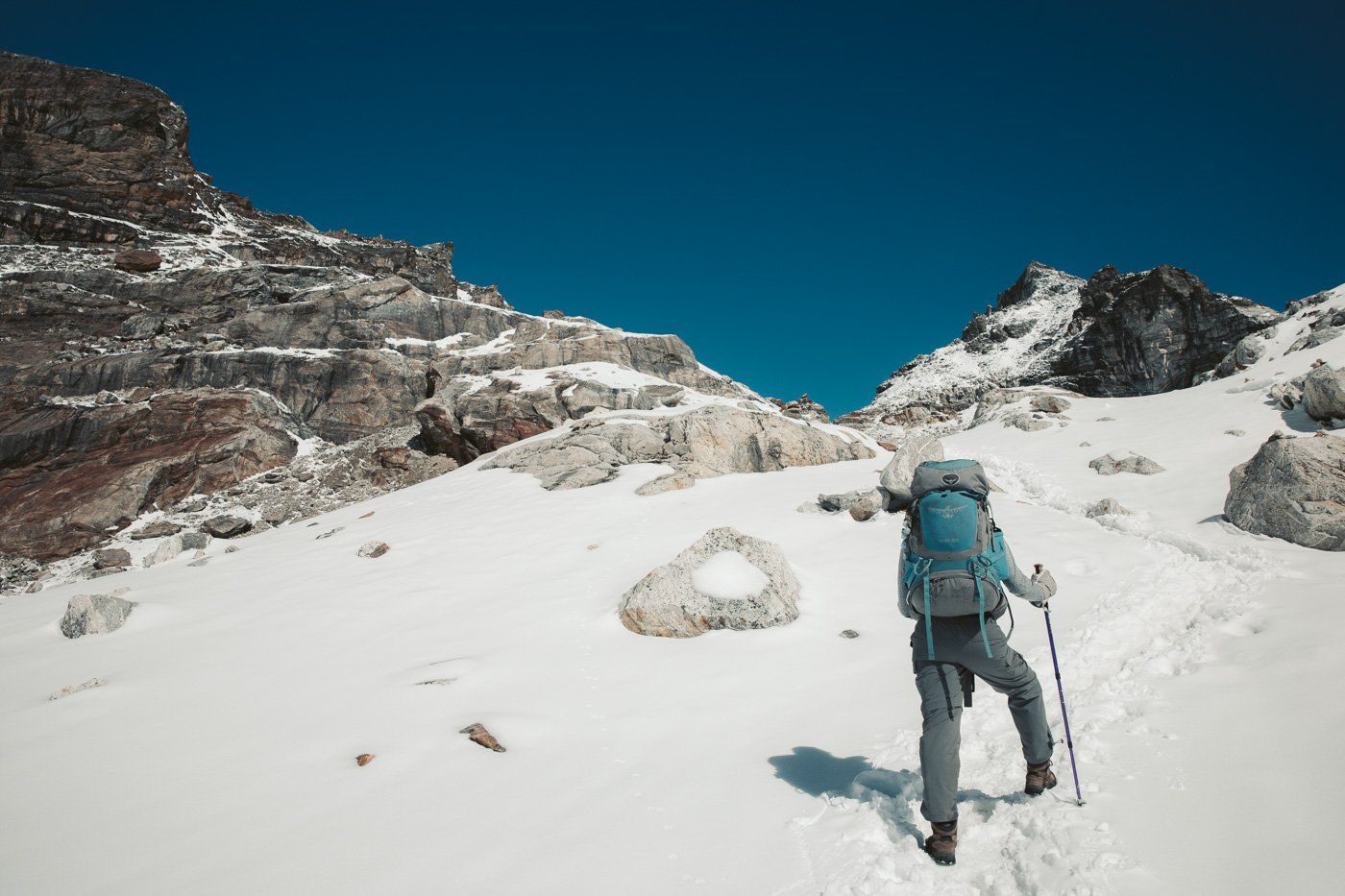


It was Day 18 of my Three Passes Trek, and I physically couldn’t open my eyes.
I was on the detour between the Kongma La and Cho La passes, making my way from Gorak Shep to the unmissable Everest Base Camp. Unfortunately, my cheap $5 sunglasses from Thamel didn’t do anything to stop the UV glare straight off the fresh snow, and I got snow blindness above 5,000 meters.
My partner had to lead me by the hand for two hours down the moraine back to Gorak Shep (5,164 m) because I was effectively blind. I was lucky. After two days in a dark tea house room, my sight returned. If the inflammation had been worse, I would have faced a $5,000–$10,000 USD helicopter evacuation bill that I couldn’t pay as a stingy backpacker on his first Himalayan trek.
So this doesn’t happen to you, I’ve written this guide based on what I’ve learned trekking in the Himalayas for 7+ years after this incident. I’ll specifically break down the specific insurance requirements for the Three Passes Trek and the providers I’ve personally used in the past for the Three Passes and other treks in Nepal.
I am a traveler, not an insurance broker or financial advisor. I’m not giving any insurance advice, the information in this guide is based on my personal experience trekking in the Himalayas. Insurance policies, altitude caps, and rescue protocols change frequently. You must read the full Product Disclosure Statement (PDS) and verify coverage for your specific nationality and itinerary purchasing.
Overview: The Reality of Insurance for the Three Passes
From experience, choosing the right policy for the Three Passes Trek is significantly riskier than choosing insurance for the standard Everest Base Camp route.
This is because the Three Passes leads you to regions that are MUCH more remote, AND you will be crossing three high-altitude passes above 5,000 m (16,400 ft), namely:
- Kongma La: 5,535 m (18,159 ft)
- Cho La: 5,420 m (17,782 ft)
- Renjo La: 5,360 m (17,585 ft)
Most standard travel insurance policies cap coverage way before 5,000 m. If your itinerary includes these passes, the "intent to travel" clause could void your policy the moment you leave Kathmandu (check your wording) So, if your itinerary includes Kongma La, you are "intending" to travel above 5,500 m from the first day of the trek.
The problem here is that if you cheap out on a standard backpacker insurance policy, you slip on an icy trail near Namche Bazaar at 3,400 m, then the insurer could deny the claim simply because your planned route exceeded their altitude limits.
Furthermore, this trek is far more remote. Unlike the main EBC trail, the passes are often hours from the nearest teahouse. If you get stuck on the top of Kongma La or the Ngozumpa Glacier, there are no yaks to carry you down.
A helicopter evacuation is often the only way out. - And this is the main thing I look for when purchasing trekking travel insurance - will I be covered if I need to get evacuated from a remote region?
Without a policy that explicitly covers these altitudes and guarantees "Direct Billing" you will likely be forced to pay a $5,000–$10,000 USD cash deposit before the pilot typically agrees to fly to get you.

So What's the Solution In Nepal?
The solution is to find a provider that includes coverage above 5,500 m and preferably, offers "Direct Billing."
In 2018, the Nepali government cracked down on a massive insurance fraud scheme where trekkers and agencies were faking rescues to split the payouts. I witnessed this first-hand when I was in Gorakshep the first time, with some tour guides getting commission there asking trekkers if they want a "cheap" helicopter ride back down to Kathmandu if they claimed their insurance.
This hurts everyone, especially the trekkers. Helicopter companies effectively stopped trusting foreign insurance cards AND premiums have skyrocketed.
Today, most pilots will not turn on their rotors until they see a literal stack of cash or a verified "Direct Billing" dispatch order. If you have a standard reimbursement policy, you (or your guide) will often be asked to provide a $5,000–$10,000 USD credit card deposit or cash before evacuation.

The Trekking Travel Insurances I've Used
After seven years of climbing and trekking in the Himalayas, including Mera Peak, Island Peak, Manaslu Circuit, and the Three Passes, I have narrowed my list down to three providers that I've used and have worked for me in Nepal.
- Global Rescue: This is my top pick. It is technically a "crisis response membership," not travel insurance. They are the only provider that consistently uses "Direct Billing" to pay pilots upfront, meaning you don't need to carry a $10,000 credit card. Note: at the time of writing only the High-Altitude Evacuation Package covered me on my quote for the Three Passes.
- World Nomads: The best "all-in-one" traditional insurance (covers lost bags, flights, etc.). However, you must select the "Explorer Plan" to get 6,000 m coverage. Be aware they operate on a "Pay and Claim" model, meaning you may have to pay for the helicopter upfront and fight for reimbursement later.
- Garmin SAR: A backup option if you already own an InReach device. While it used to be cheap, and I used to use them for years, their high-altitude plan (required for 5,000 m+) is now significantly more expensive. Like World Nomads, it is a reimbursement model, not direct billing.
Global Rescue
This is currently what I personally use for all my high-altitude trips these days from the Karakoram to the Khumbu.
This is not travel insurance though; it is a "field rescue membership". I choose them because they are the only provider that reliably pays helicopter companies upfront ("Direct Billing") on the Three Passes route.
The reason why I choose them now is that they have pre-existing contracts with major operators like Simrik Air and Kailash Helicopter. This means if I need to hit SOS, they dispatch a pilot immediately without demanding a $5,000–$10,000 cash deposit from me on the side of the mountain.
However, the standard Global Rescue membership strictly excludes activity above 4,600 m (15,000 ft). To be covered for Kongma La (5,535 m), they offer a "High-Altitude Evacuation Package" add-on.
When doing a quote now at the time of writing for the Three Passes, the high altitude upgrade costs approximately $395 on top of the base membership. Since the trek takes 18–21 days (and I always recommend a buffer for Lukla flight delays), you'll need a 30-day membership (I couldn't find an option for a 22 day membership). With the mandatory upgrade, this comes out to around $760 USD - yeah pricey.
The other thing to note is the medical gap: Global Rescue gets you to the hospital, but they do not pay the hospital bill. I pair my membership with a low-cost medical-only policy (like IMG Patriot Lite (which I've found to be pretty affordable for my trips) to cover the actual treatment costs in Kathmandu.

World Nomads
I know, choosing separate trekking travel insurance on top of your regular travel insurance is very annoying.
That's why I've heard of many trekkers using World Nomads. They offer a more traditional "all-in-one" travel insurance policy that's popular for backpackers and adventure travelers. I've used them in the past, and while I've luckily never had to make a claim, I've heard great things from other travelers since I started traveling full-time in 2018.
Their reviews generally stack up, especially in the backpacking community and in hostels around the world.
However what's really important when choosing insurance for the Three Passes specifically is the altitude caps. When doing my quote, I can see that the "Standard Plan" caps hiking at 3,000 m (9,842 ft), which isn't nearly enough for the Khumbu.
For the Three Passes, I would need to look at the "Explorer Plan," which lists coverage for trekking up to 6,000 m (19,685 ft). This safely clears the highest point of the circuit, the Kongma La Pass (5,535 m).
While technically this means I'd be covered, the main trade-off is their "Pay and Claim" model. In the Everest region, pilots often demand payment upfront. This means I might have to put the $5,000+ rescue bill on a credit card and file for reimbursement later.
However, the big upside is that unlike a rescue membership, this policy can cover Trip Interruption. If you get stuck in Lukla for three days due to weather (a very real possibility), this type of policy can help cover the cost of your extra accommodation and rebooking flights (though usually pretty cheap in my experience anyway being Nepal).

Garmin SAR
I used to recommend the Garmin "SAR 100" plan to everyone. For about $40 a year, it was an incredible deal that turned your inReach device into a safety net.
Unfortunately, those days are gone.
Garmin (via their underwriter) has completely overhauled their pricing structure. The affordable plans now strictly exclude any trip where you have an "intent" to go above 5,000 m (16,404 ft). Since the Three Passes Trek requires crossing Kongma La at 5,535 m, the standard $40 plan is void before you even pack your bags.
To be covered for this specific trek, you now have to buy the "SAR High Altitude" plan. The cost of this is now $999.99 per year. This is kind of worth it if you are doing many high altitude expeditions or trekking trips in a year, but if you're just planning one Three Passes Trek is loses out to GlobalRescue in my opinion (it's also only a rescue plan not an insurance plan).
Also, keep in mind that Garmin’s insurance is still a reimbursement model. The Garmin Response Center (based in Texas) does an amazing job coordinating the logistics, but they don't usually pay the helicopter company upfront. You will likely still need to provide a credit card hold for the flight cost and claim it back months later...

My Verdict: What I'd Choose If I Was Going doing the Three Passes Again
My personal choice is Global Rescue paired with a cheap medical policy.
It’s pricey because of the mandatory "High-Altitude" upgrade, but their "Direct Billing" and their connections is worth it for me at least. I don't want to stress about wiring $10,000 from a satellite phone if I break a leg on Kongma La.
A final warning: policies and premiums in Nepal change constantly and are only getting more expensive, so please double-check the latest fine print before you fly.