


If you’re planning a trip through Asia in and trying to figure out the best eSIM for Japan, Thailand, or South Korea, this guide will save you a lot of wasted time. I’ve spent close to a decade travelling through Asia, and it’s basically become my second home ever since I left Australia in 2018 with nothing but a backpack and a camera.
Thing is… staying connected has changed massively over the years.
I used to bounce between cafés, restaurants, and hostels hunting for half-decent WiFi. Then I moved to buying local SIM cards, which was its own headache (most Asian countries still require passports, registration, and a surprisingly formal process just to get a travel SIM).
Switching to eSIMs has been great for me, which is why I want to share this advice with other travelers looking for travel internet in Asia. It’s easily the most reliable and quickest way I stay connected now, whether I’m shooting content in Japan, working from a café in South Korea, or island hopping in Thailand.
In this guide, I’ll break down exactly how I use eSIMs across Asia, the providers that actually work, and the packages I recommend. Even though I focus on Japan, Thailand, and South Korea, the advice here applies to pretty much every country in Asia.
What Is an eSIM and Why It’s Ideal for Traveling in Asia
An eSIM is basically a digital version of a physical SIM card. Instead of lining up at an airport kiosk or hunting down a phone shop, you just buy the eSIM digitally on an app (or browser), scan a QR code, install the eSIM, activate it after landing - and you’re online within minutes.
No paperwork, no passport, and no tiny pieces of plastic to swap in and out of your phone.
If you’ve traveled around Asia for any amount of time, you’ll understand why this matters. The region has incredible connectivity, but it’s also one of the hardest places to get a local SIM quickly. Japan still requires registration and ID for most SIMs. Thailand will take a photo of your passport and fill out a form, even if you’re buying a basic prepaid plan. South Korea is even stricter; you can’t get a local SIM without proper ID, and many shops won’t even process tourists unless you buy specific “travel SIM” packages, which are very expensive in my experience.
With eSIMs, that entire process disappears. I now activate my data package on the plane, switch it on as we’re taxiing to the gate, and by the time I hit immigration, I’ve already got internet to pull up hotel bookings, maps, and the Uber app (no getting scammed by airport mafia!).

TL;DR: How I Get Internet in Asia Without Roaming Fees
The eSIM I currently use and recommend for traveling in Asia is Holafly.
I've tried and reviewed many eSIMs over the years, and Holafly is my current favorite due to their unlimited package structure at decent prices. I'll continue to update my guides if I find something better than Holafly.
Tip: Use the code WESEEKTRAVEL for 5% off any Holafly package.
Read This BEFORE You Buy an eSIM in Asia
After using the Holafly eSIM in Europe, I wrote a pretty lengthy review based on my experience. Overall, I had a great experience, it worked seamlessly and only disconnected when I got into really rural Tuscany, where no physical SIM card would work either.
However, my review has become a bit of a hit on Google, and it seems to now be the place where unhappy customers go to vent in the comments section. Unfortunately, many of these travelers have had a bad experience– they all seem to struggle to get a refund after they find out the eSIM is not compatible with their phone.
So, how to avoid this? MAKE SURE your phone is compatible with eSIMs BEFORE you buy the package. Yes, I agree that Holafly should improve their after-sales support, especially for refunds, but to be honest due to the sheer scale, it might be a losing battle (have you ever tried to get customer support from a physical telcom company?).
That's my warning, 2 cents, and general advice for other travelers. If your phone doesn't support eSIMs, then you will need to get a physical SIM card in Thailand (I recommend DTAC), South Korea (try SKT), and Japan (NTT works best)– or it might be time to upgrade your old phone!

My Go-To Asia eSIM for Travel
Over the years, I’ve tested pretty much every major travel eSIM provider: Holafly, Airalo, Truley, SimLocal, Jetpac, and a handful more.
Some have great pricing, others have better coverage in specific countries, and a few are honestly more trouble than they’re worth. After all that trial and error, Holafly is my current favorite eSIM when I’m traveling around Asia.
Why? Because I prefer their unlimited package structure. I’d rather pay for the length of my trip, whether that’s a week, two weeks, or in the case of Thailand, usually several months, than constantly check data usage or buy top-ups mid-trip.
I work online and I’m always tethering my laptop to my phone. I find that the 500 mb hotspot cap gets me by, but I wish they would increase this to 5-10 GB as sometimes if I leave my updates on I use the hotspot cap. However another option here is to check out Holafly Plans– there are no caps with this option.
Holafly isn’t perfect (no eSIM company is), but in Japan, South Korea, and Thailand, it’s been the most consistent for me in terms of speeds, stability, and how well it handles hotspot usage. Below, I’ll break down the exact package I recommend for each country, what you actually get for the price, and how to choose the right eSIM for your trip length.
Picking a Travel eSIM in Thailand
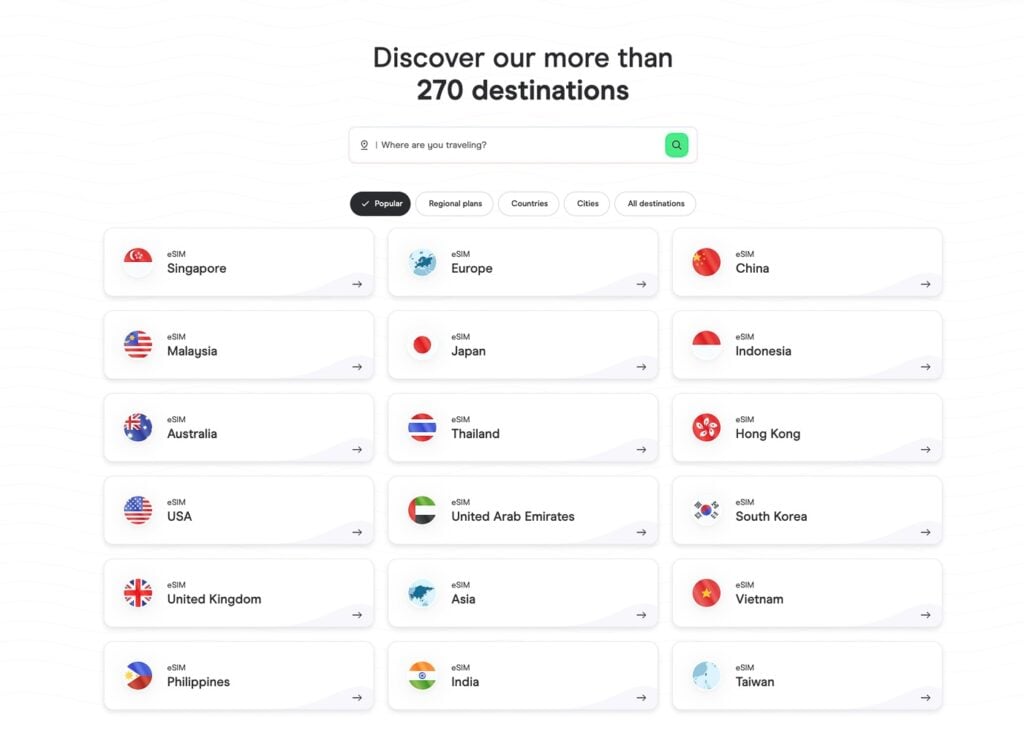
Holafly sells Thailand eSIMs as unlimited-data packages priced by days (you pay for trip length).
They use Thailand’s TrueMove (True) network and include a hotspot allowance and a Fair-Use throttle for extreme usage. If you’re a heavy user or hotspot regularly (like me), Holafly’s day-based unlimited packages remove the pain of topping up or watching GBs.
If you only need a few GB for a short layover, cheaper per-GB packages from Airalo or Nomad will cost less overall but they’re riskier if you start tethering big uploads and I have no experience using them for hotspotting.
Key Facts You Need to Know
- Holafly Thailand offers unlimited data sold per number of days (choose 1–90 days). Uses TrueMove H networks. Hotspot sharing allowed up to 500 MB/day. There’s a Fair-Use throttle above very high monthly usage (Holafly cites an operator throttle if usage ≳90 GB/month).
- Typical Holafly example prices: 1 day ~ $3, 5 days ~ $17, 10 days ~ $30, 20 days ~ $49, 90 days ~ $120– you’ll pay by trip length rather than by GB.
- Competitors (Airalo, Nomad, etc.) often sell per-GB bundles for Thailand (1 GB / 7 days, 3–10 GB / 30 days, etc.). Example: Nomad — 1 GB for 7 days = USD 5; 10 GB for 30 days = USD 12. Airalo lists similar small-GB packs (1 GB for ~€4–5 for short windows).
My take: I travel full-time and tether my laptop frequently. With a per-GB package, I used to run out mid-upload and waste time buying extra data. On a recent Thailand trip, I switched to Holafly’s day-based unlimited package and didn’t even think about data for the whole trip, which included loads of photo uploads, maps, and video calls with family and work. It worked throughout the country without me watching usage.
Japan eSIM for Travel
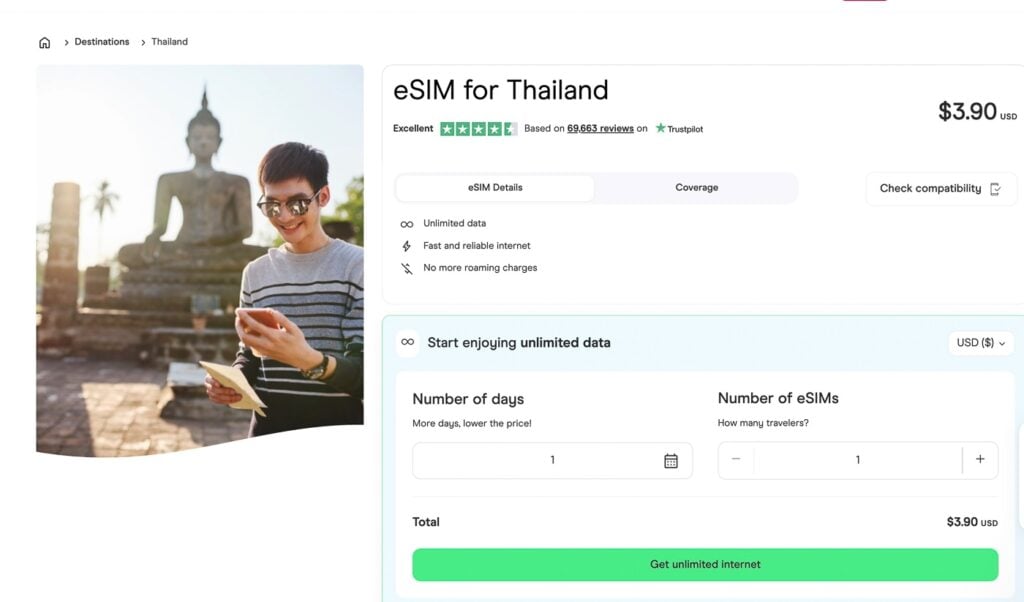
Holafly’s Japan eSIM works the same as in Thailand– an unlimited-data, day-based model. You pick how many days you need (from 1 up to 90), and pay accordingly. For someone like me who works, creates, and uploads while traveling, this removes the constant worry about hitting a GB cap.
Their Japan package uses KDDI (au) and SoftBank networks. These are major Japanese carriers, which means solid coverage whether I’m in a dense city like Tokyo or out in more rural areas, where their coverage is above 95% according to their websites.
If all you need is a few GB for maps, WhatsApp, or light browsing, a per-GB provider like Airalo (Sakura / Japan package) could save you money. But if you’re tethering your laptop, uploading files, or video calling, Holafly’s unlimited packages are much more practical.
Key Facts You Need to Know
- Package style: Unlimited data, sold per number of days (1–90)
- Network: Uses KDDI (au) and SoftBank. JapanConnect eSIM+1
- Hotspot: Allowed, but capped (Holafly lists ~500 MB/day for tethering).
- Fair-Use: There’s a throttle / fair-use policy for very heavy use (some sources indicate this happens somewhere around very high monthly data volumes).
Typical Pricing:
- 1 day: ~US$3.90
- 5 days: ~US$19.50
- 10 days: ~US$36.90
- 30 days: ~US$74.90

Travel eSIM for South Korea
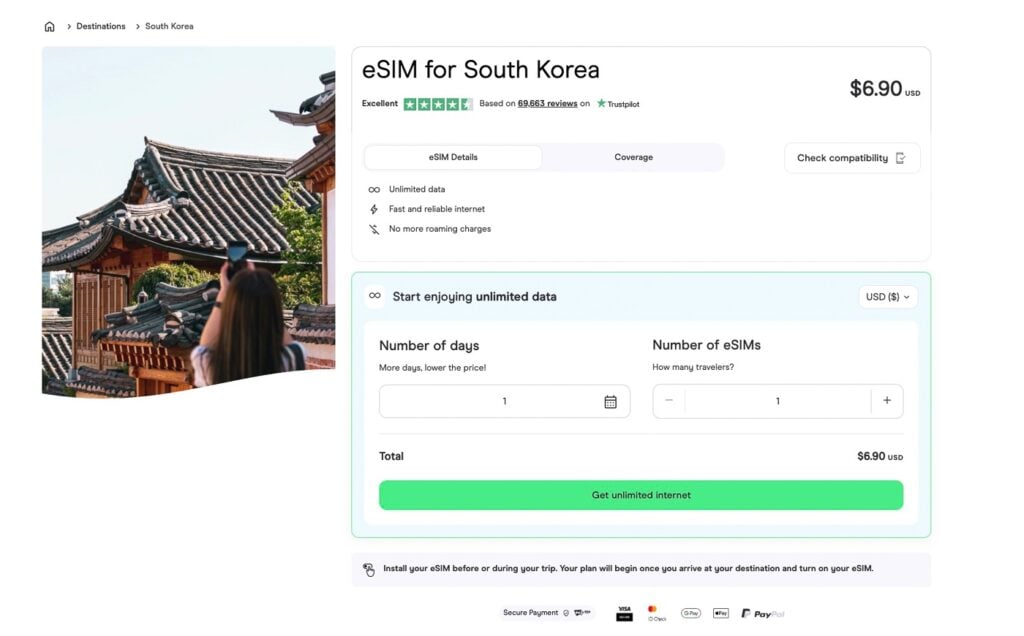
Holafly’s South Korea eSIM is, once again, built around an unlimited-data, day-based pricing model. You pick how many days you’re staying (from 1 up to 90), pay for that, and you don’t have to worry about GB limits or constant top-ups.
Holafly uses LGU (at least according to their own spec sheet) for South Korea. That’s solid since LGU's network is by far the best I've used in both cities and more rural zones, so I’ve never felt seriously constrained by coverage when using Holafly in Korea.
If you’re not using tons of data, just maps, light browsing, or occasional WhatsApp a per-GB eSIM from someone like Ubigi or Nomad could be cheaper in South Korea, but if you plan to hotspot, stream, or upload, Holafly’s unlimited packages make a lot more sense.
Key Facts You Need to Know
- Package style: Unlimited data, sold per number of days.
- Network: SK Telecom
- Hotspot: Shares up to 500 MB/day per Holafly’s package.
- Pricing: Holafly’s South Korea package ranges from US$6.90 for 1 day, which is quite expensive but there are discounts for longer periods eg. 30 days or more.
- Speed: I've found that as with most eSIMs in South Korea, there may be a speed cap (~18 Mbps) with Holafly’s unlimited data eSIM
What About A Regional Asia eSIM?
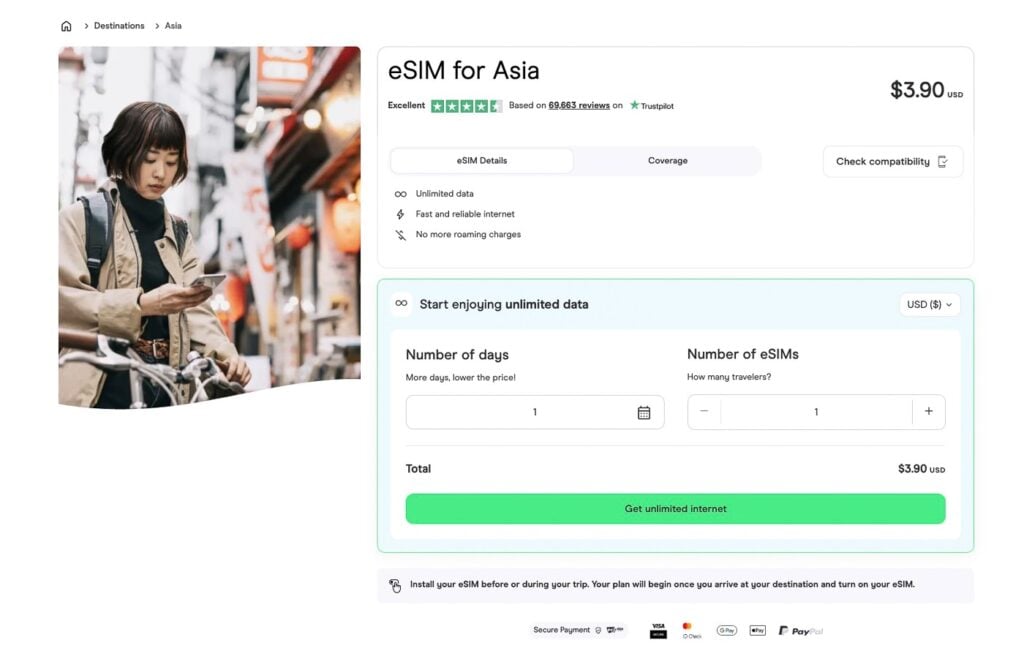
Holafly does offer a regional Asia eSIM that covers around 16 countries (including Japan, Thailand, and South Korea) and gives you unlimited data based on trip duration. That “multi-country” model sounds ideal, and is cheaper than buying a separate eSIM for South Korea.
But, after almost a decade traveling through Asia, I still lean toward country-specific plans. Here’s why: for the destinations I care about (Japan, Thailand, South Korea), Holafly’s individual packages are often cheaper and simpler than the regional one, especially when I know exactly how many days I’ll be in each place.
Swapping eSIMs as I cross borders adds a tiny step, but the savings and performance are worth it in my opinion.
Plus, when you use single-country eSIMs, you’re tapping into local networks (KDDI in Japan, SK Telecom in Korea, TrueMove in Thailand) more effectively which means stronger speeds and more reliable coverage for work, uploads, and tethering.
Final Thoughts on Staying Connected in Asia
At the end of the day, Asia is too incredible to spend your time squinting at a passport registration form in a crowded phone shop or hunting for "Free WiFi" signs in a back alley.
Whether you’re navigating the Tokyo subway or uploading 4K footage from a beach in Koh Phangan, having a reliable connection is the ultimate travel hack. While I’ve tried a dozen different ways to stay online over the last decade, the ease of an unlimited eSIM is hard to beat. If you want to skip the logistics and get straight to the adventure, you can grab your Holafly eSIM.
Use the code WESEEKTRAVEL to knock 5% off the price—it’s not a huge fortune, but it’s definitely enough for an extra round of street food or a few more rides on the Seoul metro.